On this page
How do you deliver messaging that feels fresh and personal to every prospect… while still keeping your brand consistent and your team moving fast? That tension is at the heart of great marketing, and it’s genuinely tough to get right.
This is where the best sales and marketing templates earn their keep. A good template gives you a repeatable, adaptable framework to build from, so your team isn’t starting from a blank page every single time.
But this doesn’t mean any template will do. Creating a template for a message you blast to every prospect might save you a few minutes, but if they never even open it, that time is wasted. A template is only as valuable as the thinking you put into it.
Sales enablement — and marketing in general — is really about giving your prospects the right content at the right time. At Content Camel, we spend a lot of our time researching the best ways to give your team the tools they need to craft and deliver that winning content, and to help Sales actually close.
One of the most reliable ways to do that is with proven templates for every stage of your marketing and sales funnel — from the first-impression emails you send new prospects to the webinar decks you present to thousands. Let’s walk through them, stage by stage.
Here’s what we’ll cover in this guide:
- Planning templates — messaging, personas, and team checklists that set your foundation.
- Internal sales templates — battlecards, playbooks, and competitive analysis to enable your reps.
- Top of funnel templates — eBooks and white papers that draw prospects in.
- Middle of funnel templates — webinars and one-pagers that help leads evaluate you.
- Bottom of funnel templates — price lists, sales decks, and proposals that help you close.
Marketing & Sales Planning Templates
Planning templates do double duty. They help you make an impact with prospects, but they also give you a structured chance at company introspection — and that second part matters more than people expect.
To craft a campaign that lands, you need to do the research: where your company and product are strong, where they’re weak, and how all of that stacks up against competitors in your industry. To get the most out of every other template in this guide, you’ll want that information assembled in one place and readily available to your sellers, marketers, and content creators.
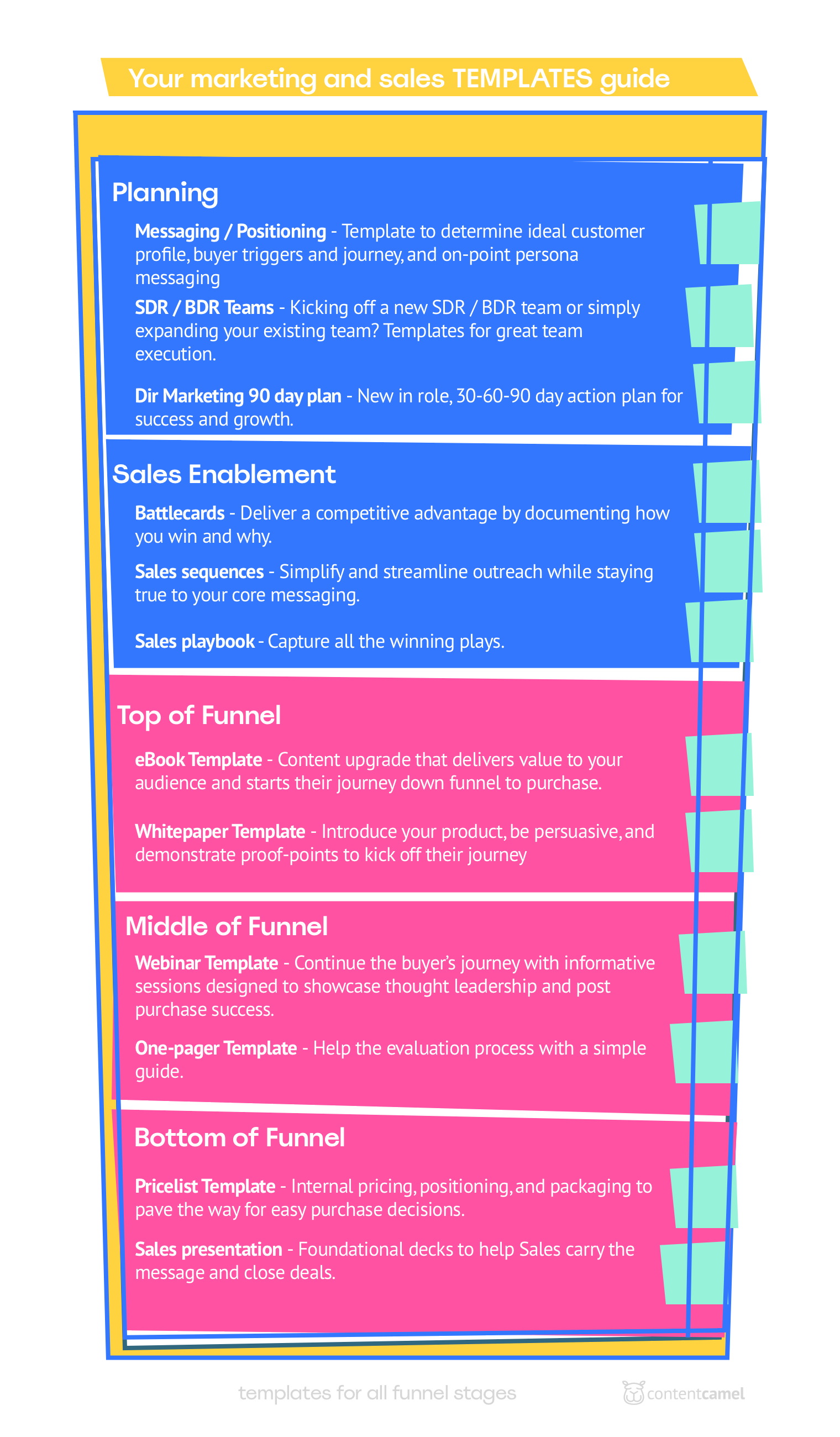
The most important planning templates are:
Together, these help you decide what to say, who’s going to say it, and how you’ll deliver it at scale.
Positioning/Messaging Template
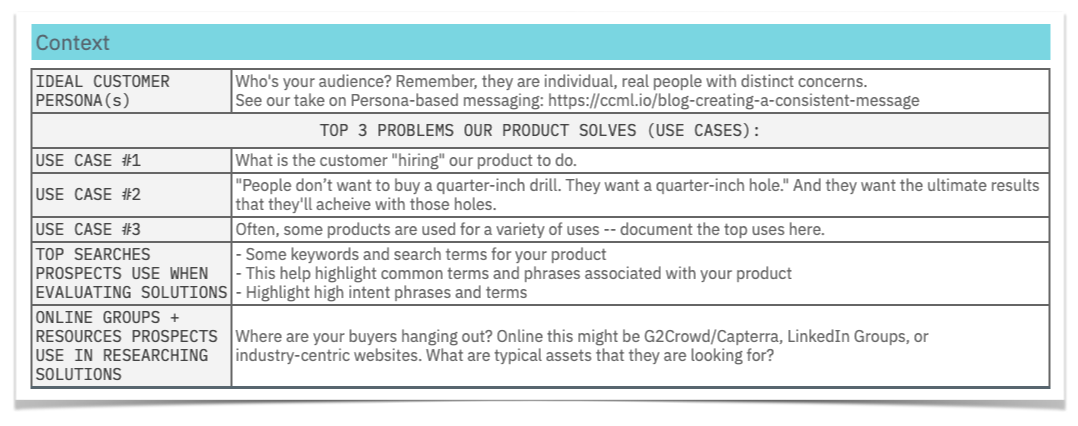
One of the most critical pieces of content your team will ever create is the positioning template — it quietly dictates so much of your strategy that it really belongs at the center of your sales stack.
A positioning template is all about how you present yourself and your product to prospects. The messaging you choose communicates a great deal more than the literal words in an email; it signals who you are. Your brand identity and culture need to shine through clearly, because that’s what establishes you as a credible, professional company right away… and you know what they say about first impressions.
That same identity needs to be consistent company-wide. When you hand your sellers and marketers templates that already bake in your branding and positioning, you make it easy for everyone to stay on-message — which is the whole point.
There are six key considerations when crafting your positioning template:
- Context — the market and moment your product lives in.
- Value drivers, differentiators, and social proof — why you, and who already trusts you.
- Path to purchase — how buyers actually move toward a decision.
- Features and benefits — what it does, and why that matters to the buyer.
- Competitors — who you’re up against and where you win.
- Product positioning and messaging — the statements that tie it all together.
It’s also worth building a buyer persona alongside your messaging — your positioning is far sharper when you know exactly who you’re talking to (your ideal customer profile, or ICP).
Download Content Camel's Free Product Messaging Template
New SDR Team Checklist
Assembling a new sales development representative (SDR) team is something to do with real care. These are the people who will be contacting your prospects, working with your content, and chasing your goals right alongside you.
It’s easy to assume SDRs are all about sales… but that undersells what they actually do. Your SDRs aren’t just making cold calls and firing off emails — there’s a considerable amount of internal effort behind every successful campaign. Depending on the industry, it can be a high-pressure role, so picking the right people matters.
You’ll also need to choose the software tools that support them. To dig into how to prepare your SDRs and make the right call on sales enablement tools, take a look at our guide on the best practices for setting up a BDR/SDR team.
SDR Team Checklist Templates
Here’s a collection of templates and resources you can use to build out your SDR team checklist:
- SDR Team Building with Vouris
- Complete Checklist before hiring a dedicated SDR Team
- Sales Development Team Building Framework by Gartner
- SDR Team Building Checklist by HubSpot
Director of Marketing First 90 Days Checklist
A new director of marketing can face a steep uphill climb stepping into the role. Every company and product is different, so your techniques and strategy have to adapt to fit.
Whether you’ve landed in an industry that’s brand new to you or one you know like the back of your hand, there are a few key steps worth taking at the start. One of the best pieces of advice is to map out your first 90 days — not just what you plan to accomplish and how, but the more granular, day-to-day routines and responsibilities that will carry you there.
Read our detailed guide
Internal Sales Templates
Not every seller arrives with the same expertise, so it’s on you to equip them with the tools and resources that enable the best selling practices in the SaaS world. Templates are an ideal place to start.
Internal sales templates include:
Your internal sales templates should be rooted in your company’s culture and values and clearly reflect your brand identity. They should also help you align with your target audience’s culture and values, so your reps connect more naturally.
They’ll need to be flexible enough to accommodate the differences between your products — and products in general. Templates should be comprehensive, but never overwhelming. They’re meant to lighten the load, not leave anyone scratching their head. Remember, you’re trying to get your sellers up to speed, not scare them off.
It also helps to give your internal templates clear training standards, so everyone walks away with the information they need to do the job well. And one last note: these templates should always be a work in progress, not a one-and-done resource. Treating them as living documents keeps your engagements sharp and helps you meet new market demands as they come.
So what are these templates, and why do you need them? Let’s get into it.
Battlecards
A sales battlecard is a concise summary of your product, your market, your customers, and your competition. It gives reps fast answers to the questions and concerns prospects raise most often.
Why do sellers need a sales battlecard?
A battlecard helps your sellers convince prospects to choose you over the competition. It hands them the data they need to handle objections in the moment and clearly distinguish you from everyone else in the consideration set.
Why do you need a sales battlecard template?
A template keeps your team consistent, so everyone delivers the same accurate information to potential buyers. It also aligns brand and messaging across sellers, so your company shows up as a united front rather than a dozen slightly different stories.
What does a sales battlecard include?
A battlecard pulls together statistics, figures, and talking points reps can reference mid-conversation. At its core, it’s a side-by-side comparison of your product, service, features, and pricing against one or many competitors.
Battlecard Templates
We’ve put together a full walkthrough on building these from scratch: Battlecard Templates 101 — what they are and how to create them. If you’d like a few more external examples to compare:
- HubSpot’s Free Sales Battlecard Templates
- Crayon’s Free Sales Battlecard Templates
- Klue’s Free Sales Battlecard Templates
Sales Sequences
Great content and a top-notch team are essential to a successful sales strategy. But if you’re doing the job well, you’ll quickly notice something else: your schedule filling up fast.
As your business grows and takes on more clients, it gets harder to track who asked for what and when each deadline falls. That’s why a clear sales sequence matters — a defined cadence of touches, follow-ups, and timing — so your pipeline doesn’t hit snags or drop deals altogether.
A few ways to tighten your sequence:
- Use shared calendars. When everyone can see the same timeline, fewer things slip.
- Set internal deadlines ahead of client deadlines. This gives you room to make adjustments before anything reaches the customer.
- Protect prep time around meetings. Carving out time to prepare for and attend a meeting leads to higher engagement and makes the most of everyone’s day. Many teams quietly lose hours to monotonous meetings and one-off email drafting.
Automation and templates can take some of that load off your team — either by guiding reps or handling the busywork outright. You can set tools to send follow-up emails, reminders, and content directly to prospects, timed to land at the ideal moment after an engagement.
And even if your sequence has served you well for years, it’s worth revisiting. This doesn’t mean rebuilding it constantly… it does mean staying current as your team, clients, and market evolve.
Sales Sequence Templates
Here’s a collection of templates you can use for sales sequences:
- Sales Email Templates by HubSpot
- Complete Guide on Email Sequences by HubSpot
- Examples of Sales Sequences by Revenue.io
- Sales Sequences by Freshworks
Sales Playbook
A sales playbook is, at its simplest, a list of resources reps can turn to when they need information mid-deal. What makes it a playbook is the expectation that they can run through it quickly and efficiently and pull exactly what they need to engage the prospect.
Why do sellers need a sales playbook?
Having a plan is great… but sometimes you have to call an audible. A playbook keeps your team aware of the entire sales process and leaves little room for inconsistency. It’s critical to scaling your sales efforts while holding onto your competitive edge.
What does a sales playbook include?
There are a number of components that can go into a playbook. Here’s what one might include:
- Customer profiles
- Common objections (with respectful rebuttals)
- Sales messaging and positioning statements
- Competitive information (competitors’ strengths, weaknesses, and strategies)
- Upsell and cross-sell opportunities relevant to specific customers or segments
- Benefits of your product or service (and specific use cases for those benefits)
- Case studies and testimonials
- Average deal size range per customer type or segment
- Your standard terms on pricing, contracting, and other financial details
Sales Playbook Templates
We asked three sales leaders how they build theirs — start with sales playbook insights from 3 experts. For a couple of external templates to compare against:
Top of Funnel Templates
The content you use to draw prospects in needs to be handled with care. Like your product messaging template, it’s there to help your team make the best possible first impression the moment someone discovers you.
Top-of-funnel content is meant for people who have noticed a problem or gap in their process and have just started looking for solutions. Because that research is in its infancy, it’s important not to come on too strong — the more organic the initial interaction, the better. At the same time, you still want content impactful enough to leave a lasting, positive impression.
This doesn’t mean you should avoid talking about your product… it does mean leading with education over pitch. Focus on the kind of helpful content a prospect would naturally stumble onto while searching out their own pain points, without hammering them over the head with offers. Done well, that interaction feels like a small relief to the prospect — their most pressing questions are answered, and now they want to learn more about what you do.
So what are these materials, and what templates power them?
Top-of-funnel templates include:
eBooks
eBooks are digital publications that dig into a specific topic in useful detail. You can position one as part of your product catalog or offer it completely free as added value for your audience.
Why do sellers need an eBook?
An eBook gives sellers another way to stand out, offering prospects a genuinely useful resource that’s suited to them. From there, you can guide interested readers further into your catalog or marketing funnel, improving your chances of converting them into loyal customers.
Why do you need an eBook template?
eBooks take a lot of upfront work to produce. A good template saves you hours by handing you pre-designed layouts, so you’re not stuck formatting from scratch. With a professionally designed template, you skip much of the design and development cost — you just plug in your content and you’re most of the way there.
What does an eBook template include?
A solid eBook template usually gives you:
- An editable, pre-designed layout (often in Google Docs)
- A fully customizable version you can edit in Microsoft Office
- User-friendly presentation pages and a cover designed in PowerPoint
- A short guide on how to use each piece, with examples
eBook Templates
Here’s a collection of templates you can use for eBooks:
White Papers
A white paper is a persuasive, research-backed essay that highlights the benefits of a product, service, or solution. Its job is to convince readers — usually prospects or investors who don’t yet know your offering — of the advantages it holds over the competition.
Why do sellers need white papers?
If you have a product, service, or solution the market really needs to know about, white papers can become an essential part of your sales process. They help you make a substantive, credible case and earn a sharper competitive edge over your peers.
Why do you need a white paper template?
A template saves both time and money. Much like an eBook template, you drop your content into a ready-made structure rather than building the document from nothing. From there, you can tailor it to your specific audience — for instance, framing it differently for investors than you would for potential customers.
What does a white paper template include?
A white paper template typically includes several cover pages and section layouts for the common building blocks (problem and needs analysis, market overviews, and so on), giving you a clear path through what can otherwise be an intimidating document to write.
White Paper Templates
Here’s a collection of templates you can use for White Papers:
Middle of Funnel Templates
Top-of-funnel content brings leads in. But then what? Once visitors arrive, they need enough information to consider — and ultimately choose — your offering as the best option. That’s the middle of the sales funnel.
Here, you’re targeting qualified leads who already know a little about your product but still need to learn more before they can make a confident decision on their own.
Middle-of-funnel templates include:
Once you know the basics, these let you create compelling content across a range of topics — the kind that gets leads interested enough to take action.
Middle-of-funnel templates really earn their place when your product or service is complex. SaaS is a good example: it can be genuinely daunting for someone who isn’t sure what they’re looking at. Without good educational material, your sales team ends up spending too much time explaining the product, when most prospects would happily get up to speed on their own with a few sales presentations, datasheets, or one-pagers. With a template for each, you can craft those assets quickly instead of reinventing them every time.
Webinars
Webinars are a great way to interact with your audience in a targeted, personal way. Typically, a company hosts a live product demonstration online, with a presenter who walks through features and fields questions from prospects or current clients. It’s an excellent format for showing — not just telling — how your product benefits the people watching.
Why do sellers need webinars?
Webinars let sellers reach a bigger audience and engage potential and existing clients at the same time. They can be expensive to produce, but a template helps you save both time and money.
Why do you need a webinar template?
A webinar template gives the host, presenter, and participants an easy-to-follow structure. It also lays out your online presentation — slides, transitions, and graphics included — so you’re not designing each one from scratch.
What does a webinar template include?
Webinar templates usually come in PowerPoint or Google Slides format, complete with images, animations, and transition effects that make it simpler for the presenter to deliver a polished session.
Webinar Templates
Here’s a collection of templates you can use for Webinars:
- Visme’s Free Webinar Templates
- Pngtree Webinar Templates for Free!
- Postermywall’s Free Webinar Templates
One-Pagers
A one-pager is, quite literally, a single-page educational document that showcases the very best of your company in an easily digestible format.
Why do sellers need one-pagers?
A one-pager conveys your value proposition quickly and in an engaging way. It helps your sellers pull together the most compelling facts about your business, so investors and buyers can grasp what you do, why you’re good at it, and where you’re headed — all at a glance.
Why do you need a one-pager template?
A template is the most efficient way to present your business in the most concise form possible. It pairs visuals with focused information to showcase your company professionally, and it saves you time while helping you tell your unique story consistently.
What does a one-pager template include?
Typically, a one-pager includes:
- A clean design and layout. Easy to scan, hard to misread.
- Your logo and contact information. So readers know who it’s from and how to reach you.
- A concise description of your product or service. What it is, in plain terms.
- The problem you solve. The pain point your buyer recognizes.
- Why you’re the best option. Your differentiators for this specific solution.
- Who it’s for. The customers who benefit most.
- What’s new or upcoming. The detail that makes your business stand out.
- Links to learn more, and a clear call-to-action. The natural next step.
One-Pager Templates
We have two internal resources that go deeper than any third-party download: our step-by-step guide on how to create a one-pager for sales and a gallery of one-pager examples for inspiration. If you’d like a blank design tool to start from:
Bottom of Funnel Templates
The bottom of your sales funnel is where you convert prospects into clients. The primary goal here is to demonstrate the value of your product in irrefutable terms — ideally in a way that even empowers your champion to take your content and win over their own internal team.
Demos, case studies, and rollout plans are all powerful tools at this stage, because each one helps the buyer picture what life looks like after they say yes. The more concrete and self-serve you can make that picture, the easier it is for them to get the green light internally.
Bottom-of-funnel templates include:
Price Lists
Price list templates help companies show what they offer and what it costs, usually inside a brochure or catalog. The template organizes your offerings into categories and lists prices, making it easy for a buyer to browse and compare at a glance.
Why do you need a price list template?
When you distribute promotional materials — brochures, catalogs, postcards — a price list lets you show potential customers everything that fits their needs in one summarized document.
What does a price list include?
A price list template typically includes a summary of what your company offers, paired with pricing for each service or product. It can be tempting to use one straight off the shelf, but every business has its own customer needs… so it’s worth customizing your own copy rather than shipping the template as-is.
Price List Templates
Before you build one, it helps to settle on your approach — our guide to pricing strategy and pricing models walks through the options. For the layout itself:
Sales Decks
A sales presentation is every business’s pitch — a structured walkthrough of your products and services, built with the goal of making a sale. The nice thing about a sales deck is its flexibility: it can be formal or informal, and it works in person, over the phone, or on a digital platform.
Why do sellers need a sales presentation?
A sales presentation is a genuinely valuable tool. It can serve as a proactive pitch, an advertisement for your brand, and a highly visible representation of who you are — so it pays to get it right.
Why do you need a sales presentation template?
A template helps your team create professional-looking presentations they can reach for in any pitch. Usually formatted in PowerPoint, Keynote, or Google Slides, it gives you the design foundation so reps aren’t rebuilding slides from a blank canvas every time.
What does a sales presentation template include?
A sales presentation template includes ready-made slides with built-in functionality — text placeholders, images, charts, and graphs. They suit companies of every size, from large enterprises to mid-sized businesses, anywhere you need to highlight products and services for prospective buyers. Case studies often live here too — if that’s on your list, our case study templates are a good companion.
Sales Presentation Templates
Here’s a collection of external templates you can use for sales decks:
- Free Sales Presentation Templates by Canva
- Sales Presentation Templates on Zoho
- Sales Presentation Templates by SlideTeam
Manage your decks, one-pagers, and more with Content Camel
How Content Camel Can Help
Templates solve one half of the problem — they help you create great content quickly. But once you have a library of messaging docs, battlecards, playbooks, one-pagers, decks, and price lists, you run into the other half: keeping them organized, current, and actually used by your team.
That’s the gap Content Camel was built to close. It gives your sales and marketing teams a single dashboard to store, categorize, find, and share every asset you create from the templates in this guide. So when a rep needs the latest battlecard or the on-brand one-pager, they reach for the right version in seconds instead of rebuilding it from scratch or sending something out of date.
A few things it lets you do:
- Keep everything in one place. No more digging through drives, inboxes, and Slack threads for the right file.
- Filter and categorize by funnel stage, product, or persona. The same way we organized this guide.
- See what’s actually being used. Track which content reps share and which assets help close, so you can double down on what works.
Good template management isn’t busywork — it’s what makes all the time you spent building those templates pay off.
Final Thoughts
A great template needs to be as reliable as it is adaptable. When it stops pulling its weight, you adjust it rather than start over. Think of it like a race car: the template makes you go fast, but every so often you’ll need to hit the pit for maintenance, swapping in new strategies, messaging, and data points the way a pit crew gets a car back on the track.
This doesn’t mean your templates are ever truly finished… it does mean that, once they’re built, you’re refining rather than reinventing. And yes, that’s still some work — but it’s far less exhausting than the alternative. Building unique, winning content for every single engagement from scratch is slow, draining, and tough to sustain in today’s fast-paced market. Start with the right templates, keep them organized, and let your team focus on the conversations that close deals.
Ready to organize the content these templates create? Get started with Content Camel for free.
Topics