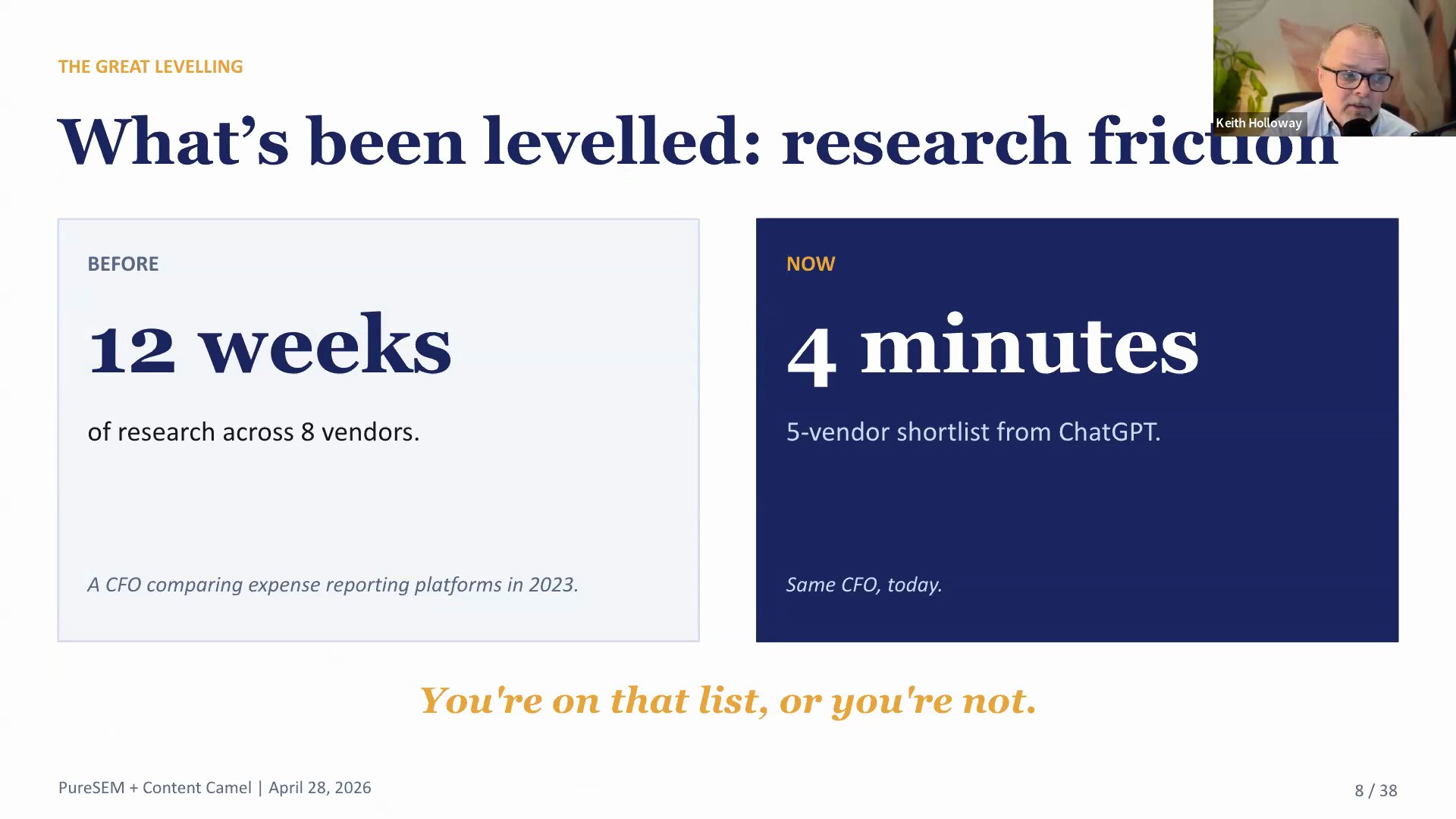
The car industry does something that almost no software company does. And it’s been hiding in plain sight.
They acknowledge, openly, that you’re shopping their competitors. Not in some vague “we know you have choices” disclaimer. In the actual buying experience. And it works. Every car manufacturer builds comparison tools, publishes competitive specs, and structures their entire sales floor around the assumption that you just came from (or are headed to) the dealership across the street.
BMW runs ads that directly reference Mercedes. Hyundai publishes side-by-side comparisons with Toyota (and BMW, and Volvo) right on their website, complete with an AI chat assistant to help you evaluate the options.
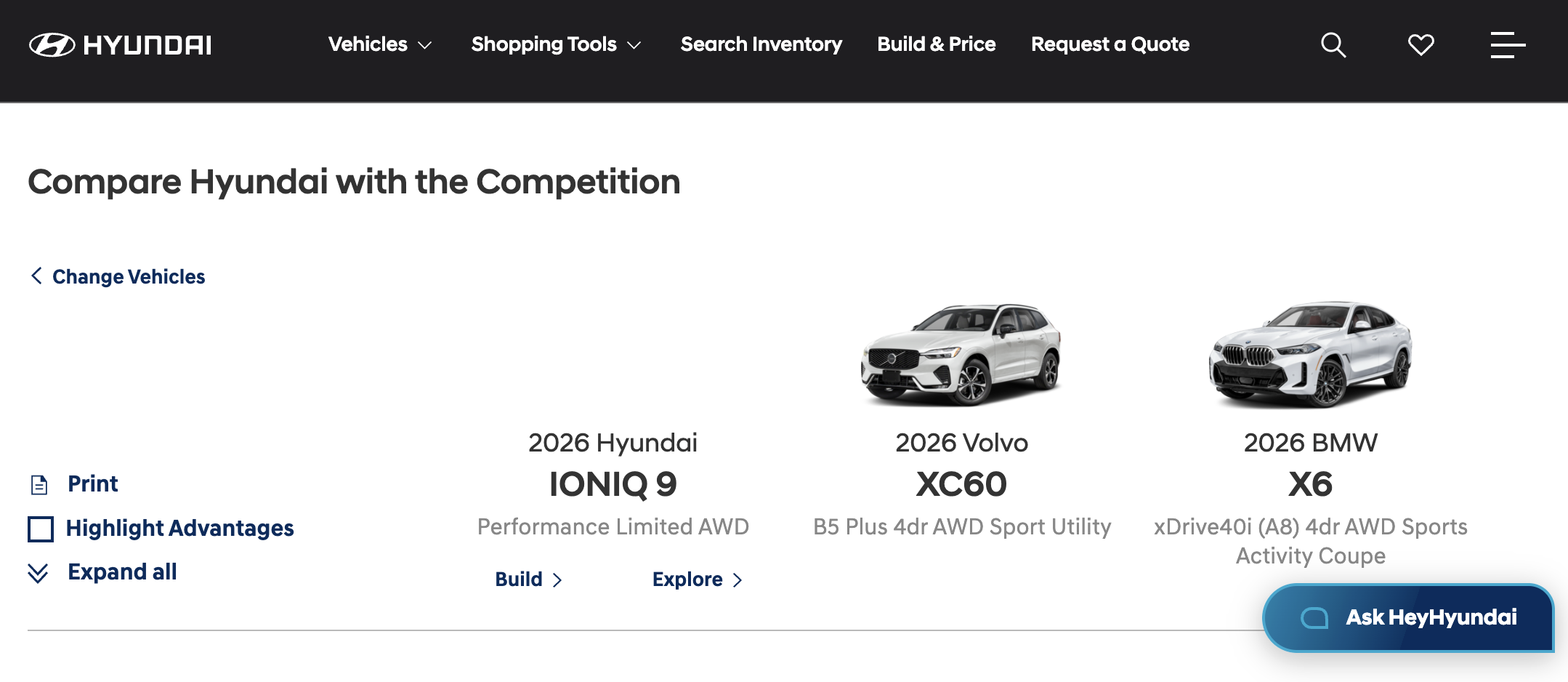
Source: Hyundai USA
The whole industry operates on a premise that most B2B companies actively deny: your buyer is comparing you to alternatives right now, and pretending they aren’t is a losing strategy.
And then Capital One went further.
The AI Concierge That Changes Everything
Capital One just launched something called Chat Concierge. It’s a multi-agent AI assistant that sits on dealer websites and helps car buyers compare vehicles, explore features, ask questions, and schedule test drives. All without talking to a single human.
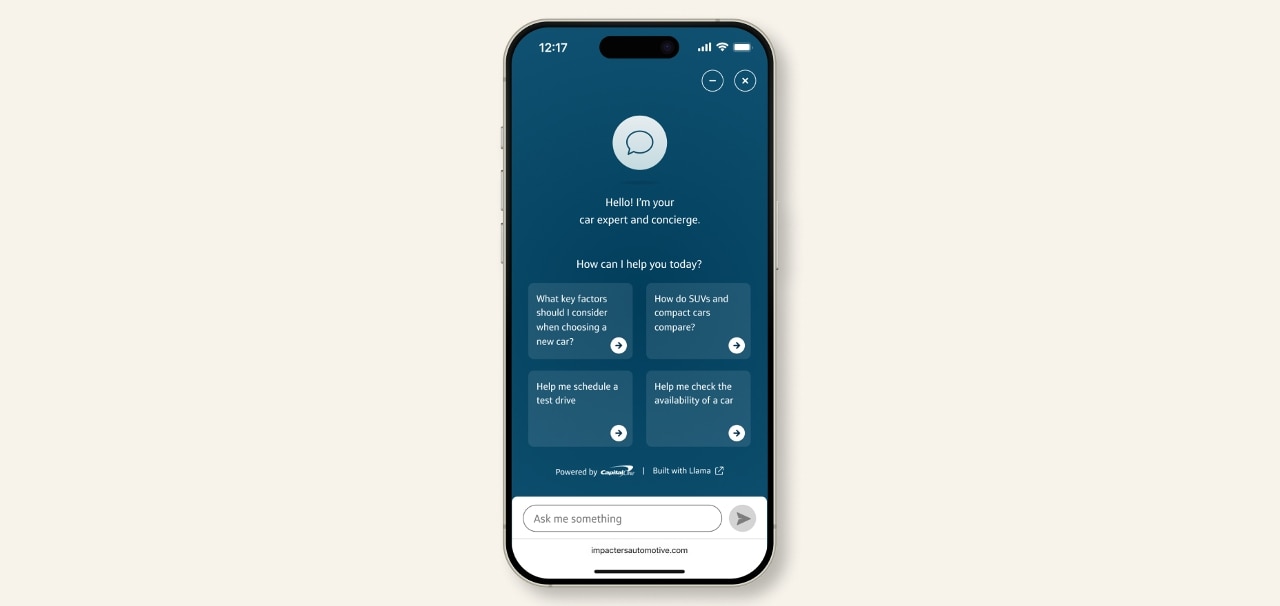
Source: Capital One
The interesting part: it goes beyond answering questions. It takes action. A buyer says “I’m looking to upgrade my SUV.” The AI asks probing questions about preferences, pulls real inventory, compares options across the lot, and books a test drive. It validates its own outputs for accuracy. And the buyer gets a frictionless experience that respects the fact that they’re doing real research, not just tire-kicking.
Capital One built this on Meta’s Llama model, customized with their proprietary data. They’re calling it “a new beachhead” in AI-powered customer experience. And they’re right. But the implications go way beyond car buying.
This is what B2B buying looks like in 18 months.
This Isn’t a Car Story
I keep coming back to this because the car industry is just the canary. The pattern playing out in B2B is the same, and the data backs it up in ways that should make every B2B marketer uncomfortable:
73% of B2B buyers now use AI tools like ChatGPT and Perplexity in their purchase research.1 Not as a secondary channel. As a primary research method.
66% of B2B buyers use AI specifically for supplier research, and 90% of those buyers trust the AI’s recommendations.2 Trust. Not “find interesting.” Trust.
Over half of B2B buyers now ask AI for a vendor shortlist before they ever open a search engine.3 Think about what that means. Your SEO ranking doesn’t matter if the buyer already has a shortlist from Claude or ChatGPT. And you’re either on that list or you’re not.
Forrester’s 2025 survey of 4,000+ buyers found that 61% of the buying journey is complete before a buyer contacts a vendor.4 That number goes up, not down, when AI tools are doing the research.
And Gartner’s prediction: by 2028, AI agents will mediate 90% of B2B purchases, channeling $15T in spend through automated exchanges.5 I wrote about this in our buyer enablement in the age of AI piece. I think the timeline might be aggressive. But the direction isn’t debatable.

What the Car Industry Got Right (That B2B Gets Wrong)
Car manufacturers accepted three truths that most software companies still resist:
Truth #1: Your buyer is comparison shopping. Every car brand publishes head-to-head comparisons. They don’t pretend the buyer isn’t also looking at Honda, Ford, or Tesla. They build that comparison into the experience. Most B2B companies? They pretend competitors don’t exist on their website and hope the buyer doesn’t notice. The buyer notices. Every time.
Truth #2: Making comparison easy works in your favor. When a car dealership hands you a comparison sheet, they’re not being generous. They’re controlling the narrative. They get to pick which dimensions matter. That’s smart. B2B companies that publish honest, structured comparison content (and make it accessible to AI agents) get to frame how the buyer evaluates the entire category.
Truth #3: The buying process should match buyer behavior, not your internal sales process. Capital One’s Chat Concierge doesn’t force the buyer through a pipeline. It meets them where they are: browsing, comparing, considering, ready to test drive. The AI adapts to the buyer’s pace. Most B2B sales processes still force buyers through stages that serve the sales team’s CRM, not the buyer’s decision-making process.
The 5 Things That Have to Be True
OK. So the buyer is using AI. The buyer knows more than your sales team does about your competitors by the time they show up. The buying process is accelerating. What actually has to change?
I keep coming back to five things. And no, I’m not calling it a framework. Just five things that I think separate the teams that adapt from the teams that slowly lose pipeline and can’t figure out why.

1. Show Up in Search (Google Is No Longer Enough)
The shift from SEO to what Gartner is calling “Agent Engine Optimization” is real and it’s happening now.
When a buyer asks ChatGPT or Perplexity to “compare content management platforms for B2B sales teams,” your content either shows up in that answer or it doesn’t. And the criteria are different from Google. AI agents don’t care about your domain authority the way Google does. They care about:
- Structured, specific claims. “14-day average implementation across 200 customers” beats “fast and easy setup” every time.
- Machine-readable content. HTML with proper schema markup beats a gated PDF that the AI can’t parse.
- Third-party validation. G2 reviews, case studies with named companies, analyst mentions. The AI cross-references.
- Honest competitive positioning. AI agents compare what you say about yourself against what everyone else says. Exaggeration actively hurts you.
This doesn’t mean SEO is dead. It means SEO is table stakes and AEO is the new edge. You need both. We wrote more about this in how AI search is changing content discovery.
2. Be Where the Buyer Is (24/7)
Capital One’s Chat Concierge works around the clock. It doesn’t take lunch breaks. It doesn’t have “business hours.” And it meets the buyer wherever they are in their decision process.
Your content needs to do the same thing. Not your sales team. Your content.
When a buyer’s AI agent researches vendors at 11 PM on a Tuesday, what does it find? Is your best case study behind a form? Is your pricing “contact us”? Is your integration documentation in a PDF that an AI can’t read?
The always-on requirement isn’t about having a chatbot. It’s about having content that answers every question a buyer (or their AI agent) might ask, accessible without friction, structured for both human and machine consumption.
This means your content library isn’t just a nice-to-have internal tool anymore. It’s the backbone of your 24/7 buyer experience.
3. Maintain Momentum (Don’t Let Deals Stall Because Content Doesn’t Exist)
This is where I see teams break down constantly. A buyer is moving fast. Their AI has already shortlisted three vendors. They’ve done the comparison. They’re ready to go deeper. And then…
They ask for a case study from their industry. You don’t have one.
They ask for integration documentation with their specific tech stack. It’s outdated.
They need competitive positioning to sell the decision internally. Your last comparison page was updated eight months ago.
The buyer’s momentum dies. Not because your product is wrong. Because your content couldn’t keep up with the pace of the buying process. And in an AI-accelerated buying cycle, that gap is fatal. The buyer (or their AI) just moves to the next vendor on the shortlist.
This is the content gap in B2B buying that we keep talking about. It’s always been a problem. AI just makes it a faster, less forgiving one.
4. Speed Up Your Internal Team
If the buyer is moving faster, your team has to move faster. Period.
This doesn’t mean “replace your sales team with AI.” Capital One didn’t replace car salespeople. They gave buyers a faster path to the test drive. The human still sells the car.
Same principle in B2B. The AI-informed buyer shows up to the sales conversation already knowing your features, your pricing, your competitive landscape. That means the sales conversation has to deliver something different:
- Insight, not information. The buyer already has the information. Give them judgment, context, and strategic thinking.
- Speed. If it takes your team three days to follow up on a demo request, you’ve already lost to the team that responds in three hours.
- The right content at the right time. Your reps need to find and share the exact case study, the exact one-pager, the exact competitive comparison for that specific deal. In minutes, not days.
This is where the sales content workflow matters. If your rep can’t find the right content in 30 seconds, you’re losing deals to teams whose reps can.
5. Content Everywhere
“Blog posts and whitepapers” isn’t a content strategy anymore. Not when AI agents are pulling from G2 reviews, GitHub repos, documentation sites, community forums, LinkedIn posts, podcast transcripts, and structured data feeds.
Your content needs to exist in every place where a buyer or their AI agent might look:
- Your website (structured, tagged, accessible)
- Review platforms (G2, Capterra, TrustRadius)
- Technical documentation (public, current, specific)
- Social and community (LinkedIn, relevant Slack communities, forums)
- Sales-specific assets (battlecards, one-pagers, case studies in your content management system)
- Structured data (schema markup, APIs, machine-readable formats)
The teams that treat content as a single-channel exercise (publish on blog, promote on social, done) are invisible to the multi-source research process that AI agents run. The teams that distribute structured content across every relevant surface are the ones showing up in shortlists.
The Readiness Checklist
I normally hate checklists. (They give you the feeling of progress without the actual progress.) But a few people have asked me what “ready” looks like, and I think it boils down to about 10 questions. Be honest with yourself.
Search and discoverability:
- Can an AI agent find and accurately describe your product without visiting your website?
- Do you have structured data (schema markup) on your key pages?
- Is your best content accessible without forms, logins, or PDF downloads?
Content depth and currency:
- Do you have case studies with specific metrics from at least 3 industries you sell into?
- Is your competitive positioning current (updated in the last 90 days)?
- Does your content address the buyer’s evaluation criteria beyond your feature list?
Sales readiness:
- Can your reps find the right content for a specific deal scenario in under 60 seconds?
- Are your reps trained to deliver insight (judgment, context, strategy) instead of reciting features?
- Do you have a defined content workflow from creation to rep activation?
Distribution:
- Does your content exist on third-party platforms (G2, docs sites, communities) and not just your blog?
So. If you checked fewer than 6 of those boxes, you have work to do. The good news: so does almost everyone. The window to get ahead is right now.
What Happens Next
The buyer isn’t getting less informed. The AI agents aren’t getting less capable. The pace isn’t slowing down.
But here’s the thing. This doesn’t mean the death of sales teams. Capital One didn’t fire their car salespeople. They built a system that gets more informed, more motivated buyers to the sales conversation faster. That’s a gift to good sales teams and a death sentence for teams running the same slow playbook they ran in 2020.
The keystone of all of it is content. Organized, structured, current, honest, accessible content. I know that sounds like something I’d say because I run a content management company. But I believed it before the AI shift, and I believe it more now. Content is the asset that shows up in AI search. It fuels the always-on buying experience. It keeps deals from stalling. It arms your reps. It gets distributed across every surface where buyers research.
If the buying process is accelerating, your content infrastructure has to be ready. Not just “we have blog posts.” Ready as in: organized, tagged, machine-readable, competitive, distributed, and updated.
We’re building a webinar around this exact shift. The AI-enabled buyer is real, and the teams that adapt their content strategy for this reality win. The ones that don’t won’t even know what went wrong. More details coming soon.
In the meantime: look at that checklist. Be honest about where you stand. And if you need a starting point, get your content organized and accessible. Because the next buyer who evaluates you might not be a human.
Related reading:
- Buyer Enablement in the Age of AI: How Not to Fall Behind
- How AI Search is Changing Sales Content Discovery
- The Sales Content Workflow: From Marketing Creation to Rep Activation
- The Content Gap in the B2B Buying Process
“73% of B2B Buyers Use AI Tools in Purchase Research, Multi-Source Analysis Finds”, Lagrange CEO, March 2026 ↩︎
“66% of B2B Buyers Now Use AI for Supplier Research”, Trax Technologies, December 2025 ↩︎
“B2B Buying Behavior Statistics & Trends”, Corporate Visions, 2026 ↩︎
“73% of B2B Buyers Use AI Tools in Purchase Research”, PR Newswire / Forrester data, 2025 ↩︎
“Gartner Expects Most Enterprises to Abandon Assistive AI for Outcome-Focused Workflow by 2028”, Gartner, April 2026 ↩︎
Ready to organize your sales content?
Start free. No credit card required.