On this page
You pay for ChatGPT or Claude. You hear big companies claiming 20,000 agents running in their business, and it makes you feel behind. So you feed a call transcript into a prompt, hit enter, and wait for the magic.
What comes back looks fine until you read it. Then the editing starts, and it slides from a light touch-up to why didn’t I just do this myself? If you run content, or you’re the content manager stuck doing that editing, you know the feeling. Patching it one prompt at a time starts to feel like whack-a-mole.
Fully autonomous agentic AI is a mirage for most marketing teams right now. What works in production is boring on purpose: a clear strategy, a workflow broken down until you can’t break it down any further, real context saved in files, an Editor/Revisor project that checks the work against your original instructions, and a person at the gates that matter.
Keith Holloway from PureSEM and I ran our third session in the series on exactly this gap. Here are the lines and stories I think matter most.
The mirage
The pitch is that one big prompt can replace an operating procedure. Hand the model a transcript or a one-liner, ask for a proposal or a long article, and out comes the finished thing.
What you get is an artifact. On the call I said a proposal built that way looks like a proposal and is completely off-brand. It also pads the thing out with content that has nothing to do with your business. Then comes a ton of rework. No surprise. The model didn’t have your pricing logic or your tone.
Asking AI to write a blog post fails the same way. Most teams don’t write like that. A good writer pulls from personas, competitors, keywords and the brand. PureSEM’s content engine is about a dozen small workflows, and a single prompt skips most of them.
Strategy, workflow, context: start in the right place
Most teams start in the middle. They jump straight to execution with prompts, before the strategy is written down and before the workflow is mapped.
Keith said a consultant suggested, about six months ago, that they break down every process into workflows. It paid off:
“Some of the things we’re doing is actually 13 steps, and if you look at one of those steps, you could break it down into 5 steps.”
Keep going until you can’t break it down any more. Then you have three layers to write down:
- Strategy: what are you trying to accomplish, and what does a win look like?
- Workflow: the steps and instructions. It’s just files, not fancy software.
- Context: the raw material, like price lists, customer objections and real call transcripts.
You can even use AI to sharpen the strategy. Hand it a past asset and ask what a company your size is missing and what could be more persuasive. Decide what fits your business, then have it write the project instructions from what you agreed. Keith’s phrase for it: we write prompts to write prompts.
A proposal system in 90 minutes
Keith built a proposal system with nothing but a Claude or ChatGPT project. No engineers, no new software. The recipe:
- Record the people who write your proposals. Get them on a call and turn on the transcript. Have them explain what they need: the price list, the customer’s objectives, the pricing rules, the template.
- Let the AI write the instructions. Drop the transcript into a new project and ask it to create a project for writing proposals. Read what it produces and fix what’s off. Keith’s take: that prompt will be much better than the one you’d write yourself.
- Load the context. Upload your price lists, your proposal templates and three to five great past proposals.
- Run it on a real call. Drop in a fresh sales-call transcript and ask for the proposal.
That’s about an hour for the discussion and half an hour to set up the project. Ninety minutes in, you have a system.
Then the first real run. Keith dropped in a transcript from one of his better sales calls:
“It was, like, 95% done. A proposal like that would have normally taken me 2 or 3 hours.”
After a light touch-up to remove the AI tells and put it in his own voice, he said a proposal like this is ready about 10 minutes after the call ends. It used to be a drag, sometimes a day or two.
Check it with fresh eyes
Better instructions help, but they only get you so far. The model will still miss things, which is the case for a second check.
So build an Editor/Revisor project. Keith’s version has none of the context that went into the draft. It only reads the finished proposal cold, next to the original instructions. Did the draft follow them? Are the prices right? Did it repeat a mistake I flagged before? It might come back and say this is actually 85%, change these three things.
We keep the Editor/Revisor separate so it isn’t biased by how the draft was made. That tends to beat trying to one-shot it.
There’s a second loop here. When you edit a draft by hand, feed your edited version back and ask what instruction change would have prevented those edits. Over time you edit less.
Those are the fancy names, “self-healing systems” and “agentic loops.” Stripped down, it’s what I said on the call. You have a plan. You execute it. Then you check that you executed it to the original instructions.
The other piece is grounding. Keith said it plainly:
“AI will make stuff up. So, if it doesn’t know the answer, it just reaches, and it doesn’t ever want to say it doesn’t know.”
PureSEM learned that through trial and error and built a grounding system. Their content briefs trace every claim to a validated persona doc, a quote from a call transcript or a knowledge base. For one regulated client, the knowledge base included the legislation itself.
Human gates matter more with AI, not less
Automation amplifies everything. Each person now has a content team behind them. Volume goes up fast. Keith had a line for what happens when the inputs are sloppy:
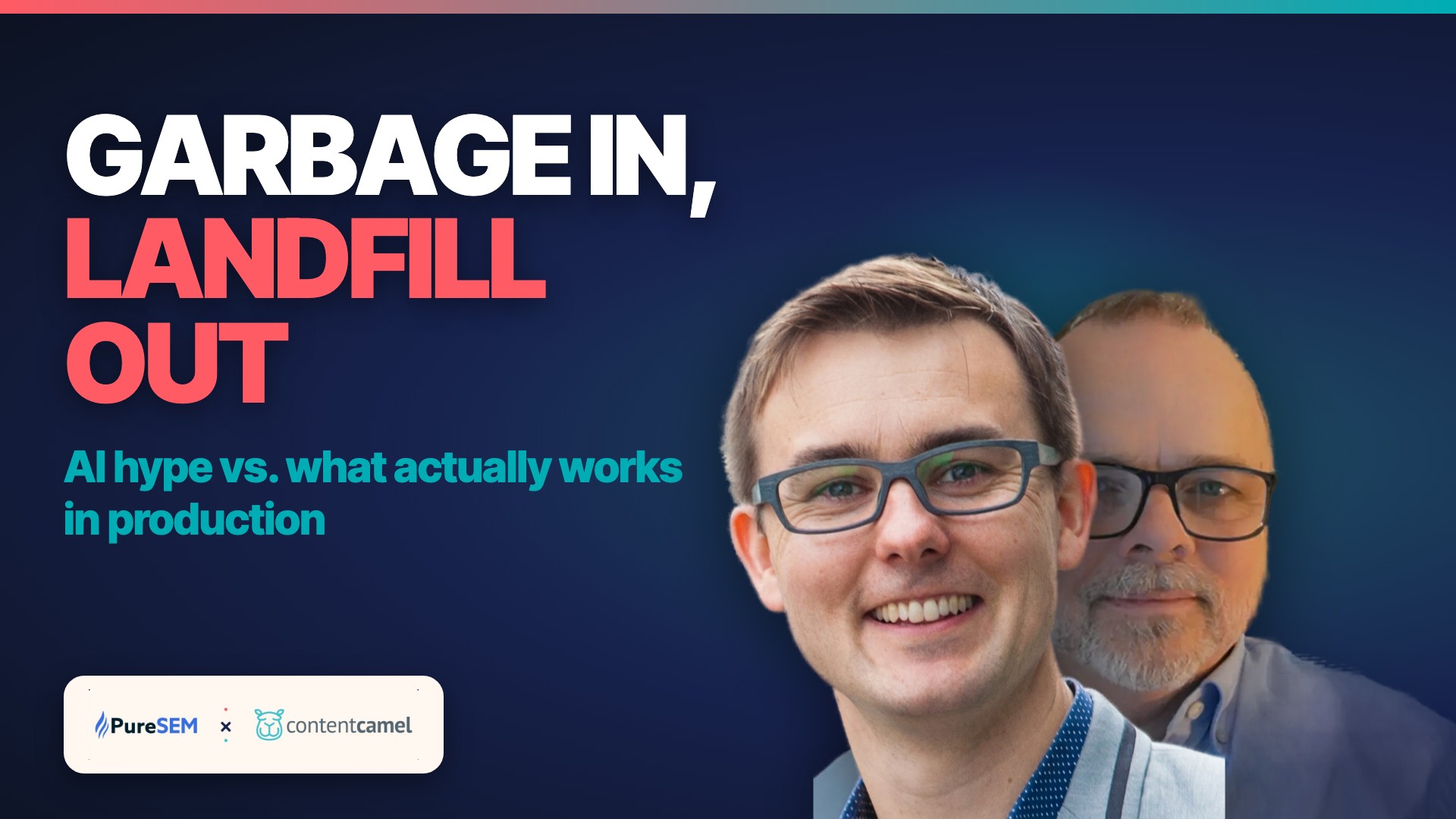
“With AI, it’s garbage in, landfill out. And the processing of that landfill is, you might as well just throw it out and do it yourself.”
Put human review at the key steps, and you avoid the rework. At PureSEM, the engine plans a content hub, then a person approves the brief before the article gets written. Fixing a brief is cheap. Fixing a finished draft isn’t.
We run the same pattern in two internal builds. The social-listening one is still a prototype, an internal tool we don’t sell.
Social-listening lead finding. Can we spot high-intent buyers from what they post?
- Trigger: a new marketer at a mid-size company.
- Find and sort: a tool called Apify runs the search daily against our criteria. We dedupe the results, then AI classifies them. Code can’t judge the squishy stuff. AI handles it well, like whether a person matches our definition of high intent.
- Hand off: it drafts a LinkedIn connect message and pushes the lead into our CRM, with a Slack note explaining why. The outreach itself is all human-driven.
The newsletter loop. On the call, Keith brought up that the newsletter used to be the biggest pain in my professional life. This is how we fixed it.
- Source: a weekly run, say Monday, curates fresh sources. No fresh context, no good output.
- Sort: AI buckets them as evergreen, topical or product-centric and pulls quotes and stats.
- Draft and check: a multi-step process builds the through line and drafts in our tone. Then it checks the draft against the strategy, the writing quality and the through line.
- Human touchpoints: three of them. We review sources, check the through line, then edit the final by hand.
Buy the commodity, build the core
We’re in what I called the primordial soup stage. It reminds me of early SaaS: lots of point solutions, not much connecting them. Today you can connect things with Zapier, n8n and MCP servers. Point Claude or ChatGPT at ClickUp or monday.com. Now you can talk to your task board.
Keith’s advice for the noise, in short: buy the commodity, build the core. He said content generation is probably cheaper and better to buy than to build. Build the processes that make your business different. How you turn a call into a proposal, say, or how you find leads.
It also changes the job. In my words from the call:
“Every team member is now a manager of a team, potentially.”
Where to start right now
- Pay for the tool. Claude and ChatGPT both run about $20 per person per month. On June 30, Keith said ChatGPT had no minimum, so two people could share projects. Claude Teams needed five seats. Check current terms.
- Use projects. Give them real instructions and files. An empty one is just a chat folder.
- Spend an hour a day. You don’t have to go from 0 to 100. An hour a day adds up.
- Run the top-five-pains exercise. Each person lists the five biggest pains in their job. Compare notes, then attack the first one.
- Ignore the token-cost chatter. Get it working first. Optimize after.
Missed the earlier sessions? Here’s part 1 on the AI-enabled buyer and part 2 on moving from prompts to pipelines. The whole series is on YouTube, in the “AI for B2B Marketers: Content Camel x PureSEM” playlist. Curious how AI systems read your brand today? PureSEM offers a free AI visibility assessment.