The spreadsheet that only one person understands
Your team has a channel list. Reach, some past campaigns, a gut feeling about events. Someone opens a spreadsheet, adds a column for “effort,” maybe one for “cost,” and types numbers into cells until a sort order shows up. Everyone nods in the meeting. Nobody quite remembers why sponsorships scored where they did, and the header row with the actual weights belongs to whoever built the thing.
That’s not a knock on that person. Weighted scoring in a spreadsheet beats picking channels by whoever spoke last in the meeting. The failure shows up later. The goal shifts from awareness to pipeline. Every cell needs retyping by hand, or nobody bothers. Either way, the ranking quietly goes stale.
We hit this ourselves working through a real quarterly channel exercise: 25 channels, seven criteria, one spreadsheet tab that got more tangled every time someone re-typed it. Mid-exercise, the header-row weights changed. Every score had to be re-entered, because cells were scored against the weight instead of on a fixed scale. Re-weighting anything meant redoing everything.
Channel Scorecard: the fix is separating two things that got tangled together
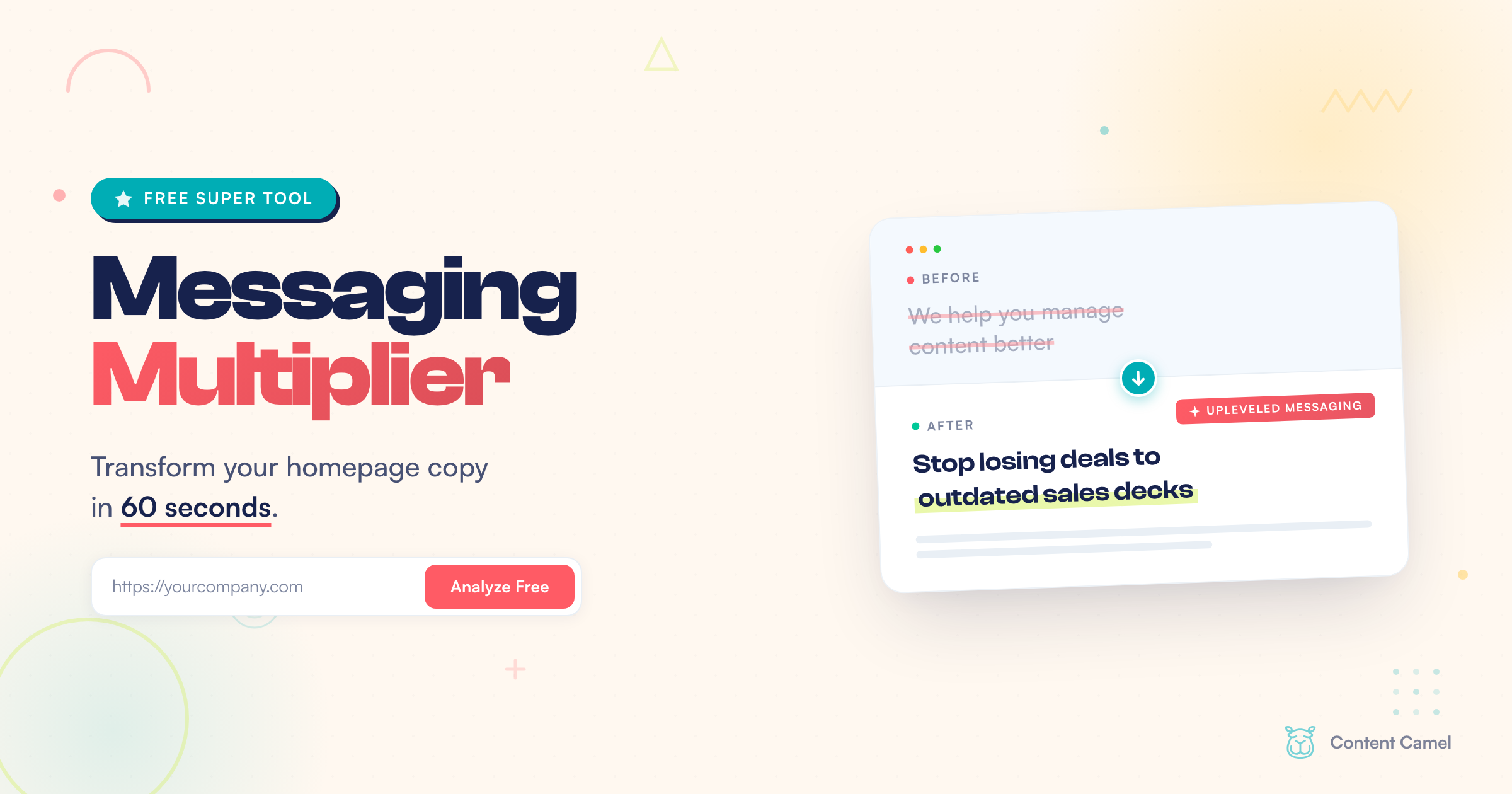
Channel Scorecard is the free tool we’re building to fix that, launching soon alongside the Messaging Multiplier and Product Messaging Multiplier on our free tools page.
The fix itself is small: score every channel 0 to 5 on each criterion, independent of any weight. Set weights separately, as percentages. Re-weight later and nothing needs re-scoring.
Criteria split into two sides. Benefit covers reach, conversion, shareability, and how easily a channel can be outsourced. Cost covers hard cost, effort, and lead time. Each side’s weights sum to 100, and dragging one weight up rebalances the rest automatically — no spreadsheet gymnastics.
The math, in full:
Benefit = Σ(score ÷ 5 × weight)across the benefit criteriaCost = Σ(score ÷ 5 × weight)across the cost criteriaScore = 50 + (Benefit − Cost) ÷ 2
A channel that maxes out benefit and costs nothing scores 100. A channel that costs everything and gives back nothing scores 0. Everything else lands somewhere between, sorted, instead of squinted at across a spreadsheet tab someone else built.
Built for the argument, not just an answer
Scoring alone doesn’t fix the actual problem, which is that one person’s numbers are one person’s assumptions. So Channel Scorecard is built for a team: everyone gets a link, scores independently by display name, and the tool flags any channel where scores spread by two points or more. Those cells become the meeting’s real agenda, instead of a ranked list nobody argues with because arguing with a spreadsheet feels rude.
Switch the goal — Distribution, Conversion, Speed, Bootstrapped — and the ranking re-sorts live. The weights moved. The scores didn’t. That’s the entire point of keeping them apart.
Results land on a benefit-versus-cost map, quadrants named Quick wins, Big bets, Fill-ins, and Money pits (you already know which one event sponsorships lands in). Drag a channel more than two spots from where the model put it, and the tool asks for a one-line reason. That reason is the part a spreadsheet can never hold onto, and the part that actually explains the call six months from now when someone asks why paid social lost its budget.
The top five each get a first-step field, so the shortlist leaves the room with owners attached, not just a rank.
What you walk away with
Everything above exports as a deck:
- Title slide — team name, date, goal preset
- The vectors and weights the team used
- The scoreboard, top-10 bar chart
- The benefit-versus-cost map
- Where the team disagreed
- Where they overrode the math, and why
- The shortlist with first steps
Every slide carries our attribution. The last one adds a link to duplicate the scorecard for next quarter. The weights and channel list carry forward; only the scores reset.
No login required. Send the edit link to your team and the view link to everyone else who needs to see where things landed.
Who this is for
Marketing teams of two to ten at B2B companies staring down next quarter’s distribution plan — directors and VPs of marketing, product marketers, founders doing their own marketing. Anyone who has argued about channels with nothing but a gut feeling and a spreadsheet only one person can edit.
Try what’s live now
Channel Scorecard is still in build. While you wait, the Messaging Multiplier rewrites your homepage headlines in about 60 seconds, and the Product Messaging Multiplier builds a full positioning framework straight from your product page. Both are free, no signup required. Find every free tool we ship, including this one the day it launches, on our free tools page.
Frequently Asked Questions
What is a marketing channel scorecard?
How do you prioritize marketing channels?
How is the score calculated?
What weights should I use?
Channel scorecard vs RICE or ICE: what is the difference?
Why score as a team instead of one person?
What if the ranking is wrong?
Which marketing channels are included by default?
Is Channel Scorecard free? Do I need an account?
What do I get at the end?
How often should we re-score channels?
Who is this for?
Ready to organize your sales content?
Start free. No credit card required.