Looking for a PathFactory
Alternative?
PathFactory and Content Camel solve different problems. PathFactory is a content experience platform for demand gen. Content Camel is a sales content management tool. Here’s when each makes sense.
If you need to organize, find, share, and track sales content: with AI powered search and buyer experience pages:
Try Content Camel free: $25/user/month, no credit card required.
Updated October 2026

PathFactory vs Content Camel
| Content Camel | PathFactory | |
|---|---|---|
| Primary use case | Sales content management | Content experiences for demand gen |
| Free trial | Yes. No credit card | Demo only |
| Pricing | $25/user/month ($300/year) | Quote-based (enterprise pricing) |
| Contract | Monthly, cancel anytime | Annual |
| Content management | Yes, organized by funnel stage, type, tags | Yes; focused on content tracks |
| AI powered search | Yes | AI recommendations |
| Chrome extension | Works in all web apps | No |
| Buyer experience pages | Yes | Yes (content tracks) |
| Content analytics | Shares, views, engagement, search analytics | Engagement, content consumption paths |
| ABM / demand gen features | Basic (via sites) | Yes (core strength) |
| Buyer intent data | No | Yes |
| Best for | Sales teams finding + sharing content | Marketing teams driving demand gen |
Two different problems
PathFactory excels at creating content experiences; curated content tracks that guide prospects through a journey, with AI driven recommendations and intent data. It’s built for demand gen and marketing operations teams running ABM campaigns.
Content Camel excels at content management, organizing your sales collateral so reps can find, share, and track it. AI powered search, collections, buyer experience pages, and analytics. Built for marketing and sales teams that need content organized and accessible.
If you’re a demand gen team building content journeys: PathFactory.
If you’re a sales team that needs to find and share the right content: Content Camel.
AI powered search and analytics
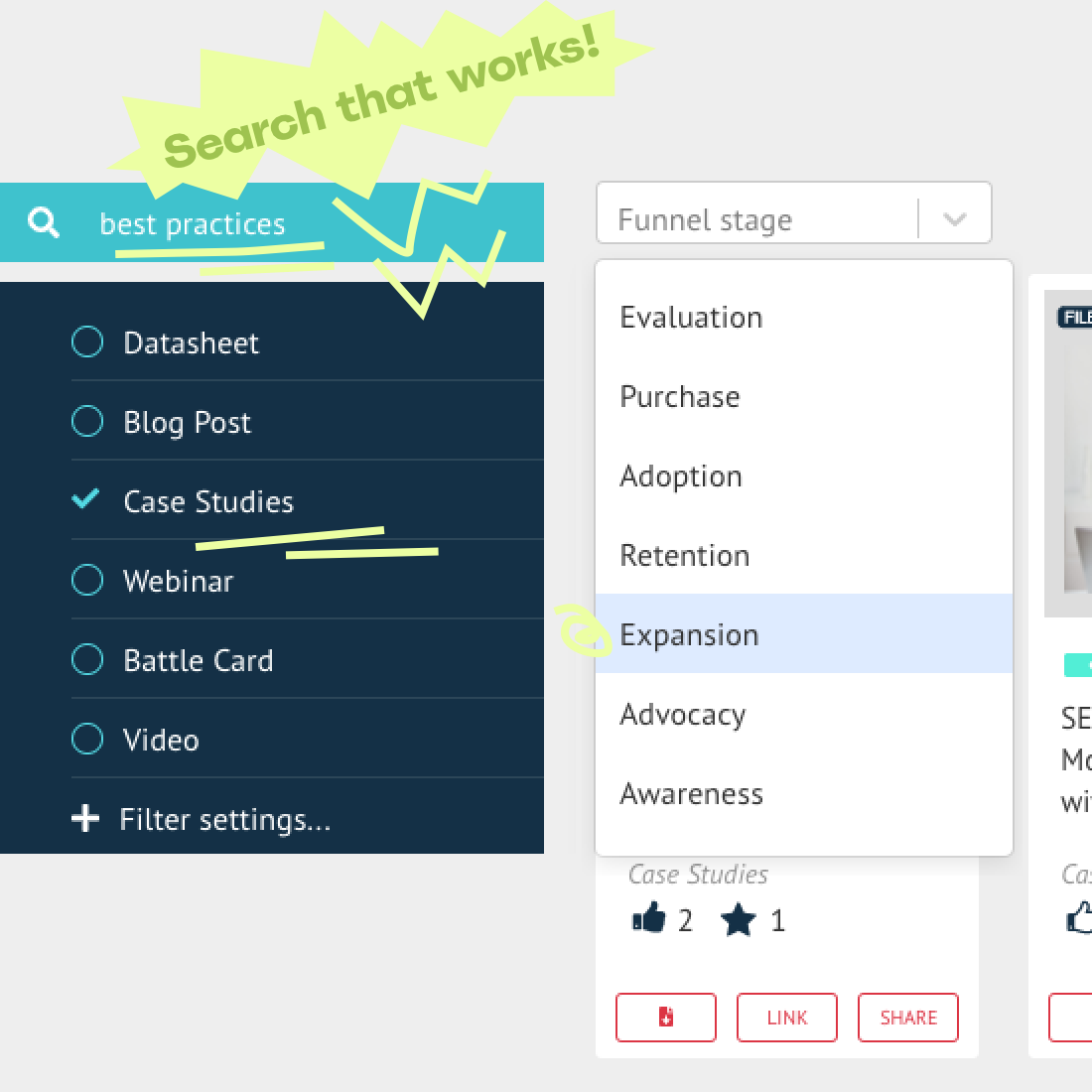
Content Camel’s AI search uses fuzzy matching, metadata indexing, and faceted filtering. Plus search analytics showing what your team searches for and what they can’t find. That data drives your content strategy.
Content management done right.
Why teams are evaluating PathFactory alternatives
Acquisition uncertainty. PathFactory was acquired by Uberflip’s parent company in 2024. Like other PE-backed consolidations in sales enablement, this creates uncertainty around roadmap, pricing, and platform direction. Teams that valued PathFactory’s independence are re-evaluating options.
Enterprise pricing complexity. PathFactory moved to quote-based pricing with annual commitments and implementation costs. Teams that need content management but not full demand gen automation are looking for focused alternatives.
Over-engineered for basic needs. Many teams adopted PathFactory for content organization but only use 20% of its demand gen features. They’re paying for buyer intent data, content journey automation, and ABM analytics they don’t need.
Implementation overhead. PathFactory implementations take weeks to months with technical setup, content migration, and team training. Teams that need to be live quickly are seeking simpler alternatives.
Different tools for different jobs
PathFactory and Content Camel look similar on the surface; both manage content, both have analytics, both create content experiences. But they solve different problems for different teams.
PathFactory is a marketing tool. It creates curated content journeys (“tracks”) that guide prospects through an ABM or demand gen funnel. It tracks content consumption patterns and provides buyer intent signals. It’s built for marketing operations teams running sophisticated content-driven campaigns.
Content Camel is a sales tool. It organizes your content library so reps can find, share, and track assets in their daily workflow. AI powered search, Chrome extension for in-app access, collections that become buyer microsites, and analytics that show what’s working.
When to choose PathFactory
- You’re running ABM campaigns with complex content journeys
- You need buyer intent data from content consumption patterns
- Your marketing ops team manages the tool (not sales)
- You want AI driven content recommendations in prospect-facing experiences
- Your budget supports enterprise pricing with annual contracts
When to choose Content Camel
- Your reps can’t find the content marketing creates
- You need a searchable content library organized by funnel stage and type
- You want a Chrome extension so reps access content from Gmail, Salesforce, or any web app
- You need analytics on what content is being shared and what’s aging
- You want to be live in days at $25/user/month
Some teams use both: PathFactory for the demand gen content experience, Content Camel for the sales content library. They’re complementary, not competitive.
What PathFactory does that Content Camel doesn’t
Content journey automation. PathFactory creates AI-driven content tracks that guide prospects through sequential experiences. If a prospect reads a white paper, they’re automatically recommended the next logical piece. Content Camel focuses on helping reps find and share content, not automating prospect content journeys.
Buyer intent data. PathFactory tracks which prospects engage with content and provides scoring based on consumption patterns. This feeds into marketing automation for lead scoring and sales handoffs. Content Camel tracks shares and views but doesn’t provide predictive lead scoring.
ABM campaign integration. PathFactory integrates with marketing automation platforms to deliver account-specific content experiences. Content Camel creates personalized buyer microsites but doesn’t integrate with campaign automation tools.
Content consumption analytics. PathFactory shows how prospects move through content journeys, time spent on each asset, and engagement patterns. Content Camel shows what content is being shared by your team and what’s performing, but doesn’t track prospect behavior in detail.
What Content Camel does differently
Sales-first workflow. Content Camel lives in your sales workflow via Chrome extension. Access content from Gmail, Salesforce, LinkedIn, or any web app. PathFactory requires switching to a dedicated platform.
AI-powered search. Find any asset in seconds using natural language search. “Competitor battle card for healthcare” returns exactly what you need. PathFactory organizes content into tracks; Content Camel makes everything searchable.
Collections → buyer microsites. Any group of content becomes a branded microsite with one click. Perfect for ABM follow-up, deal rooms, or partner enablement. Build these in minutes without involving design teams.
Search analytics for content strategy. See what your team searches for and what they can’t find. That feedback loop tells marketing exactly where content gaps exist. Most teams discover their biggest problem isn’t missing features; it’s missing content.
Cost transparency. $25/user/month with no contracts or minimums. PathFactory uses enterprise pricing with annual commitments and setup costs.
The pricing reality for a 25-person team
| Content Camel | PathFactory | |
|---|---|---|
| Annual licenses | $7,500 | $25,000+ (estimated) |
| Setup & implementation | $0 | $10,000 - $25,000 |
| Training & onboarding | Included | $3,000 - $8,000 |
| First year total | $7,500 | $38,000 - $58,000 |
That’s $33,500+ in first-year savings. For most teams, that budget difference funds the content creation that actually drives revenue.
The enablement landscape in 2026
Worth noting: the enterprise enablement space is consolidating rapidly. Highspot merged with Seismic, Showpad merged with Bigtincan, and pricing is going up across the board. For teams evaluating content tools, focused solutions like PathFactory (for demand gen) and Content Camel (for sales content) offer more value per dollar than enterprise bundles.
See our Best Sales Content Management Tools (2026) for a broader comparison.
Schedule a walkthrough; I’ll help you figure out if Content Camel, PathFactory, or both is the right call.
Frequently Asked Questions
Is PathFactory or Content Camel right for my team?
How much does PathFactory cost?
Does Content Camel have AI features?
Get organized. Get more visibility.
Organize. Share. Track. Enable sales with your best content.