On this page
Most teams don’t build a sales stack. They accumulate one.
A CRM somebody bought in year two. A shared drive with a folder called Sales Decks FINAL (use this one). A sequencing tool, a notetaker a rep expensed, and two e-signature accounts the team half forgot about. And now every one of those tools has an AI button on it.
We first wrote this guide in 2021. A lot moved since then, so here’s the updated version: what belongs in the stack, which tools we’d shortlist for each slot, and where the AI features change the work (versus where they’re a new label on an old feature).
Full disclosure: we make Content Camel, and it’s in here. We’ve tried to be straight about where it fits and where something else fits better.
Still sending six attachments after every meeting?
What’s a sales stack?
A sales stack (also called a sales tech stack, or a sales enablement tech stack) is the set of software your sales team uses to find, work and close deals.
We find it easiest to plan by the job each tool does. There are four levels:
- Organize: where deals, contacts and content live.
- Deliver: how reps move a deal from qualified opportunity to decision (the mid-funnel, SQL to close).
- Close: proposals, quotes and signatures.
- Train: keeping reps sharp and on-message.
Zoom, Slack and Google Workspace are table stakes, so we left them out.
Sales enablement checklist for your stack
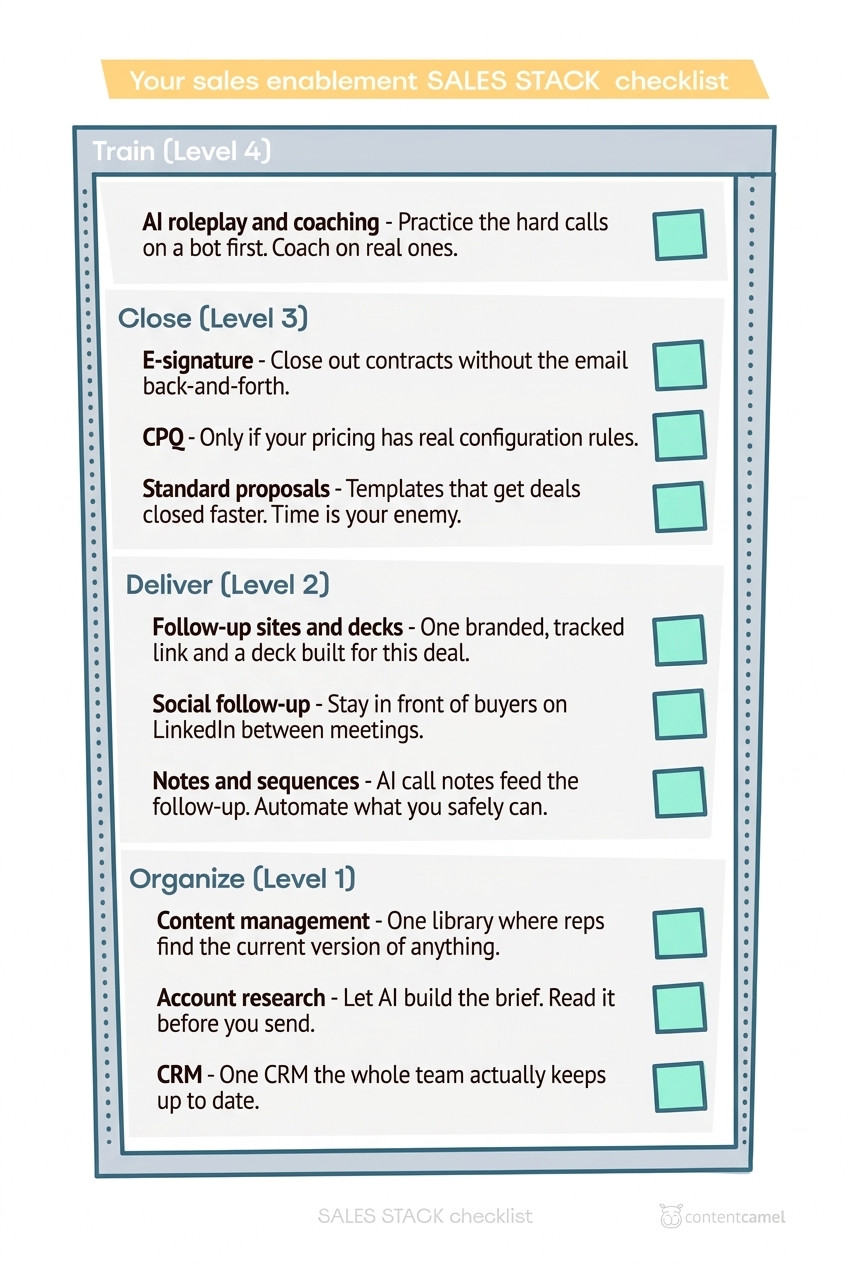
| Sales Enablement Checklist | |
|---|---|
| Organize - Level 1 | |
| A CRM the whole team actually keeps up to date. | ❏ |
| A way to research accounts and enrich contacts without an hour of tab-hopping. | ❏ |
| A sales content library where reps can find the current version of anything. | ❏ |
| Deliver - Level 2 | |
| Branded, tracked follow-up the champion can forward to the buying committee. | ❏ |
| Tailored decks per deal, built from approved slides. | ❏ |
| Social follow-up on LinkedIn, so reps stay in front of buyers between meetings. | ❏ |
| Meeting notes and call recordings that feed the follow-up. | ❏ |
| Sequences for the follow-up you can automate. | ❏ |
| Close - Level 3 | |
| A proposal tool with templates, so reps aren’t rebuilding the same doc. | ❏ |
| CPQ, only if your pricing has real configuration rules. | ❏ |
| E-signature. | ❏ |
| Train - Level 4 | |
| Practice and coaching on the calls that matter, with messaging updates rolled out when they change. | ❏ |
For the content side of this, our sales collateral checklist by funnel stage lists what to have ready at each stage.
Why the stack matters more now
Salesforce’s 2026 State of Sales report found the average seller spends 40% of their time selling. That’s from a survey of 4,050 sales professionals. The other 60% goes to admin, research and hunting for things.
Then Gartner surveyed 646 B2B buyers and found 67% would prefer a rep-free buying experience (we dig into what that means for content in our buyer enablement tools roundup). Alyssa Cruz, a senior principal analyst there, put the consequence plainly:
Sellers can’t rely on static collateral to carry influence in those moments.
Put those together and you get the two jobs of a modern stack. Give reps their time back. And make sure whatever they send keeps selling when they’re not in the room, because a typical buying group has six to 10 stakeholders. Most of them won’t join your call.
AI is aimed squarely at the first job. Notetakers, research agents and drafted emails claw back real hours. The second job is where most stacks we see still have a hole.
A note on pricing: figures below are list prices we checked in October 2026, per seat per month unless noted. Several vendors publish no price at all and sell annual contracts through a sales call. We call that wild west pricing, and it matters for one reason: with annual billing, a slow rollout means you’re paying for seats you aren’t using yet.
Level 1: Organize
CRM
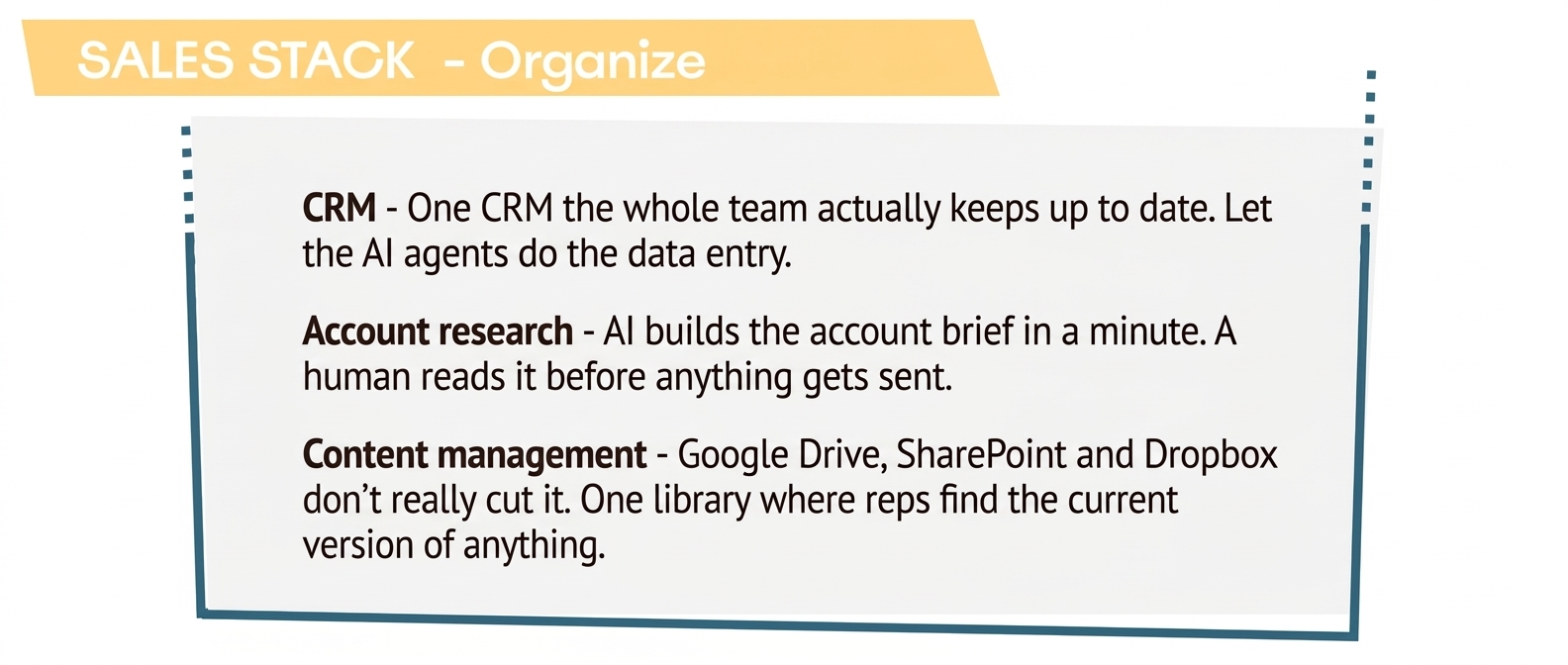
The CRM is still the backbone. What changed is that every major CRM now ships AI agents that research accounts, update fields and draft emails. Most of that’s sold on credits or as an add-on, so check what’s actually in the seat price before you compare.
- HubSpot: Free CRM for up to two users. Sales Hub Pro starts at $90 a seat on annual billing, plus a one-time $1,500 onboarding fee. Its Breeze AI agents run on usage credits. The easiest full suite for a team without a dedicated admin. Pricing
- Salesforce: From $25 a user (Starter Suite) up to $550 (Max). Agentforce, its AI agent layer, is an add-on from $125 a user below the top tier. Still the pick for complex orgs with sales ops staff to run it. Probably overkill for a 10-person team. Pricing
- Pipedrive: A pipeline-first CRM from $14 a seat (annual). Reps can set it up and run it themselves, which is the whole point. Pricing
- Attio: The newer, AI-native option. Free for up to three seats, Plus from $35 a seat (annual). Ask Attio answers questions about your pipeline and creates records for you. Good if you’re starting fresh with no Salesforce history to migrate. Pricing
Account research and data
This is the slot AI changed the most. Building an account brief used to take a rep the better part of an hour. An agent now does a decent first pass in about a minute.
It’s also where a lot of the slop comes from. An “AI-researched” opener that mentions a prospect’s podcast appearance from three years ago still reads as automated, so have reps read before they send.
- Clay: Enrichment tables that check several data providers in turn, plus Claygent, an agent that researches the web and fills in custom fields. Free plan; paid plans start around $167 a month for the team (their page lists two different figures, so confirm). Pricing
- Apollo: A contact database with sequences and a dialer built in. Free plan with no time limit, paid from about $49 a user on annual billing. A solid all-in-one for smaller teams. Pricing
Sales content management
The slot most stacks skip. It shows up later as a rep sending last year’s pricing deck to a CFO.
Content Camel: One library for every asset, wherever the file lives today. AI search reads the contents of your files, so a rep can ask for “something for a CFO worried about implementation time” and get the right case study instead of zero results. The browser extension puts the library inside Gmail, LinkedIn and the CRM. And analytics show marketing what reps share and what buyers open. They also show what reps search for but can’t find (your content roadmap, basically). Solo is free for one user. Team is $25 per active seat, billed monthly, no minimums, and viewers are free. Pricing
For a side-by-side of the whole category, see our comparison of the best sales content management tools for 2026.
Highspot: Now branded Highspot by Seismic. A strong fit for large enterprises with a dedicated enablement team that wants content, training and coaching in one platform. Pricing is by request and contracts are typically annual. More options
Level 2: Deliver – from SQL to close
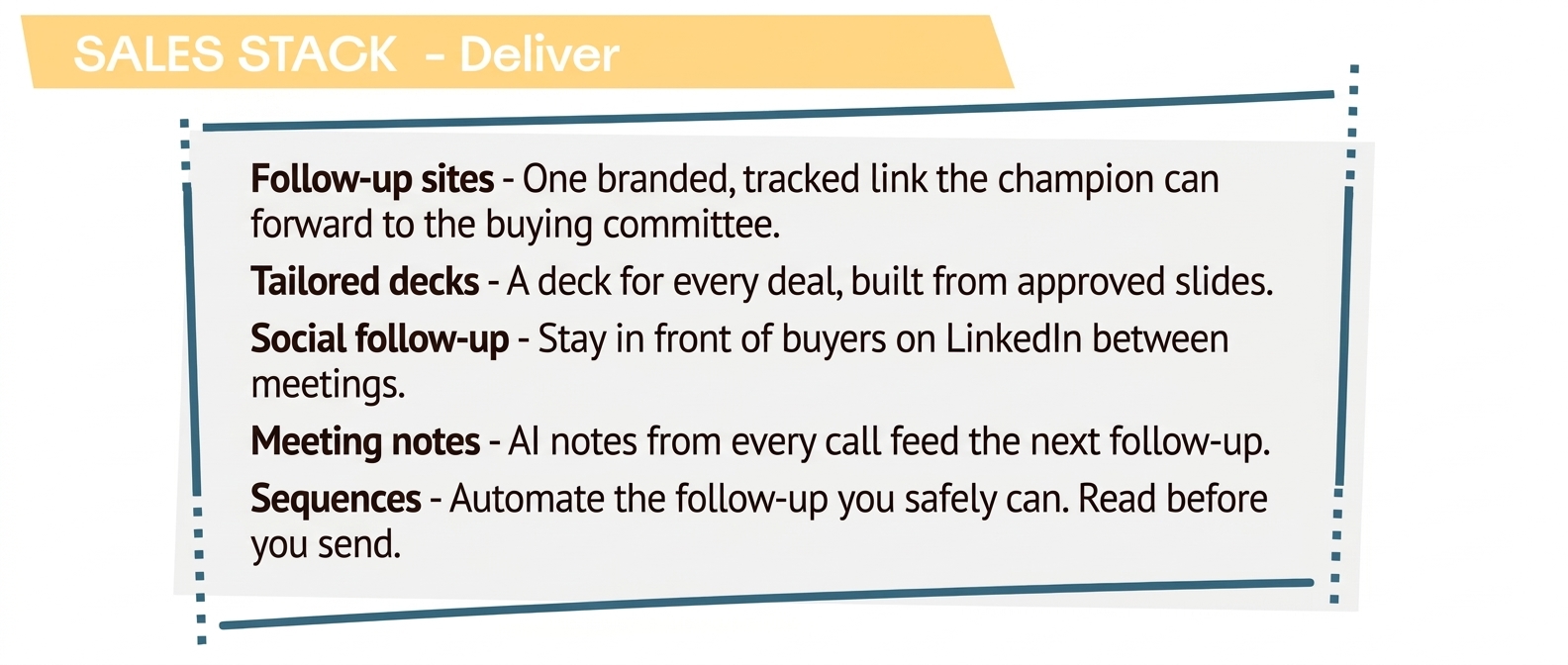
This is where deals stall.
The discovery call went well. The champion is bought in. Now they’ve got to sell you internally to five people you haven’t met, using whatever you emailed them. Three weeks later the opportunity is “still evaluating” and the rep can’t quite say why.
The tools in this level keep a deal moving between meetings. It’s also the level we built Content Camel for, so weigh our opinion accordingly.
Buyer-facing follow-up sites
Content Camel turns follow-up into something the buying committee will actually open:
- One link instead of six attachments. Bundle the deck, the case study, the security doc and the pricing one-pager into a collection. Publish it as a branded microsite on your domain in about two minutes, add a note for this deal, and the champion forwards one link.
- A deck built for this deal. The Deck Composer breaks your master deck into a searchable slide library. A rep picks the 11 slides this prospect needs and publishes a tracked deck. When marketing updates the master, the changed slides flow into every deck built from it.
- Know who’s engaged. Page-level analytics show which pages each viewer opened, how long they stayed and when they came back. If someone opened the pricing page twice on Tuesday, that’s your next follow-up.
- Answers when you’re not there. Turn on AI chat on a site and the committee can ask questions, answered from the content you chose.
- Plays, so reps aren’t guessing. Playbooks map assets to deal stages, with notes on when to send each one and what to say about it.
- Proof for marketing. CRM Insights joins content engagement to your HubSpot deals, so you can see which assets show up in closed-won deals and which reps send them.
Not all follow-up sites are the same, though. A deal room is a per-deal workspace, usually with a mutual action plan and tasks, and more setup per deal. A microsite is a curated, branded, tracked page of content. Content Camel does the second, and it’s fast, which matters when a rep is carrying 30 open opportunities. If your sales cycle runs on a shared mutual action plan, a deal room tool may suit you better (DealHub and Allego both include one). We compare those in our roundup of the best digital sales room software for 2026.
Cost: free for one user, $25 per active seat on Team. Pricing
Social follow-up on LinkedIn
Another “just checking in” email won’t revive a quiet deal. Your buyers are on LinkedIn, though: posting, commenting, reacting. Showing up there with something useful to say keeps you in the conversation without adding to their inbox.
Extrovert keeps reps visible to their prospects on LinkedIn without the whole day disappearing into the feed. You load the people you’re working. Each day you get two short lists: posts worth a comment and people worth a DM, each with the reason why. Extrovert drafts the comment or message from the actual post and your own writing style. You review and approve before anything goes out (about 20 minutes a day, by their count).
It also tracks how warm each relationship is. So before you make the ask, you can see who’s been engaging back.
That makes it a natural mid-funnel layer next to your follow-up sites. Content Camel shows you who on the committee opened what. Extrovert keeps you in front of those same people between meetings.
Cost: $49 per LinkedIn seat on monthly billing, with a 10-day free trial and no card. Pricing
Meeting notes and conversation intelligence
The notes from the last call are the raw material for the next follow-up. AI made this category cheap enough for every rep to have one.
- Fireflies: Records, transcribes and summarizes meetings, and you can ask it questions about past calls. Free tier, paid from $10 a seat (annual). We use it ourselves.
- Avoma: Notes plus AI-drafted follow-up emails, with call scoring and deal-risk alerts as paid add-ons. From $19 a seat (annual). Pricing
- Gong: The enterprise standard for conversation and revenue intelligence, now with agents that draft follow-ups and flag deal risk. No published price.
One heads-up from the old version of this list: Chorus is now part of ZoomInfo and isn’t sold on its own anymore.
Video
A two-minute video walking through the proposal often travels further inside the buying committee than the proposal does.
- Loom: Async screen recording, owned by Atlassian. Business is $18 a seat, or $24 with AI titles, summaries and filler-word removal. Free Starter plan with a 5-minute cap. Pricing
- Vidyard: Video for sales teams, with a free plan. Its Video Agent sends personalized AI-avatar videos when a buyer takes an action. We’d test that one with a few real buyers before rolling it out; some will find it charming and some won’t.
Sequences
For the follow-up you can safely automate. Use the AI drafting, and read before you send.
- Outreach: Sales engagement with AI agents for meeting prep and deal risk. Note the new domain. No published price.
- Salesloft: Merged with Clari in late 2025, so engagement, call recording and forecasting now sit under one roof. No published price.
- Apollo (above) covers sequences well for smaller teams.
Level 3: Close
Proposals
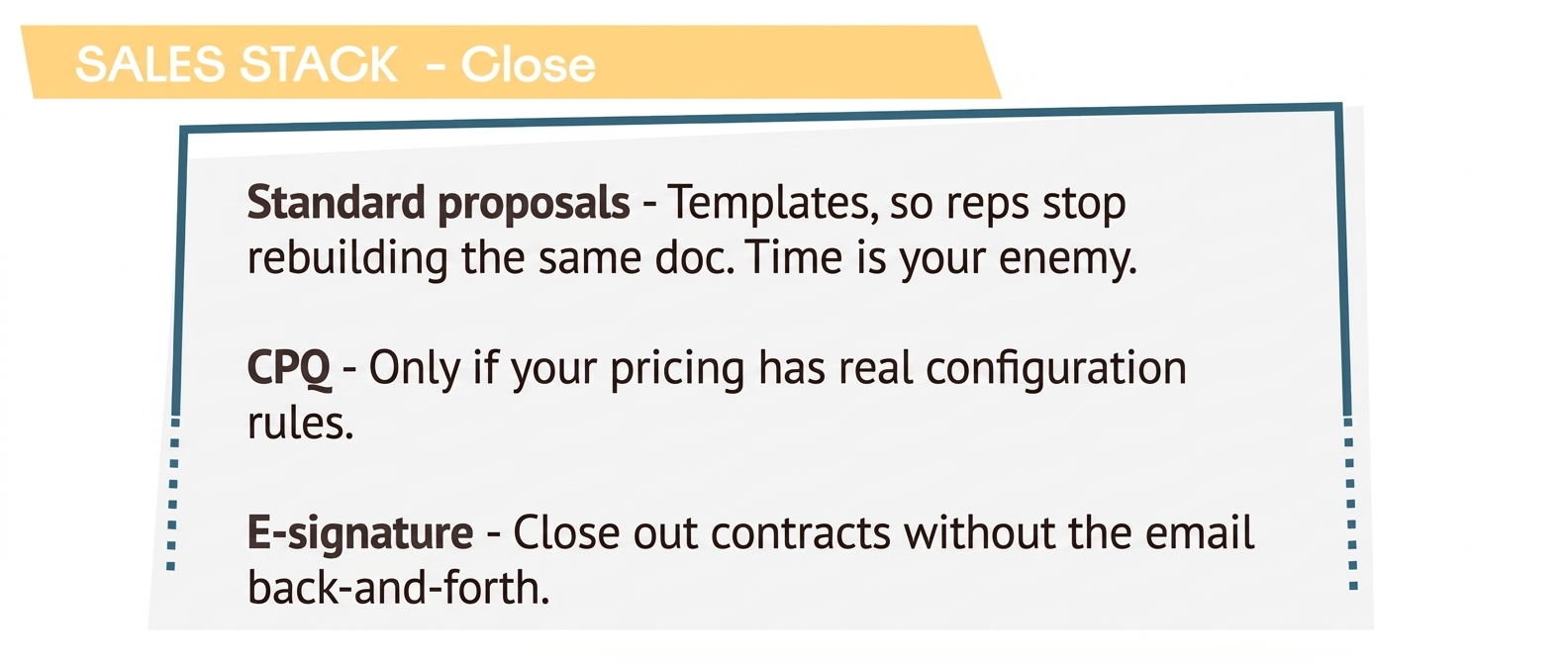
Templates mean reps stop rebuilding the same document from scratch. Most of these now include AI drafting, and a couple connect to Claude and ChatGPT directly.
- PandaDoc: Proposals and documents with e-signature built in. Free plan for a handful of docs a month, paid from $19 a seat (annual). Pricing
- Proposify: Proposal design through sign-off, from $35 a seat (annual), 14-day trial. Pricing
- Qwilr: Proposals as interactive web pages instead of PDFs, from $35 a seat (annual). Pricing
Quoting and price configuration (CPQ)
Only buy CPQ if your pricing has real configuration rules (bundles, tiers, approvals). If a rep can quote from a price sheet, your CRM’s built-in quotes are probably enough.
- DealHub: CPQ, contract management and digital sales rooms in one product. Sales-led pricing.
- Salesforce shops: Salesforce stopped selling its classic CPQ to new customers and now points buyers to its Revenue Cloud product. Check the current name and terms with your account team before you plan around it.
E-signature
- DocuSign: Still the default. Its Intelligent Agreement Management tier adds agreement workflows on top of signing.
- Dropbox Sign: Formerly HelloSign. Free for signing only, paid from $15 a month on monthly billing. Pricing
- If you picked PandaDoc for proposals, you may not need a separate tool at all.
Level 4: Train
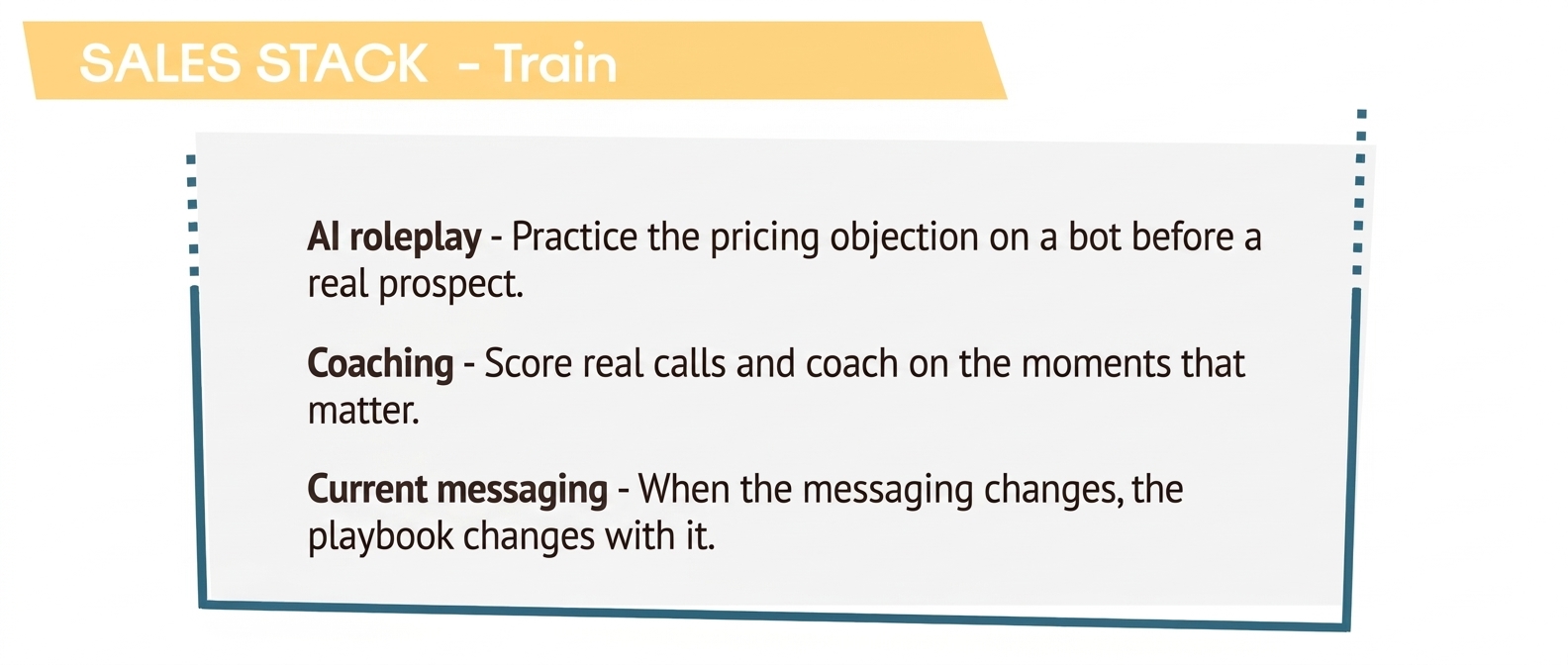
AI roleplay is the most useful thing AI did for this level. A rep can practice the pricing objection against a bot on Monday instead of practicing on a real prospect on Thursday.
- Second Nature: An AI roleplay partner for discovery, cold calls and objections, with scoring. No published price.
- Hyperbound: AI buyer roleplays, plus scoring of real calls and coaching delivered into reps’ tools. You can try it without a card.
- Allego: A broader readiness platform: learning, coaching, AI roleplay and digital sales rooms. No published price.
- Guru: A knowledge base that answers reps’ questions with citations and respects permissions. Custom pricing.
- Ambition: Coaching, scorecards and pipeline reviews for sales managers. No published price.
Training also goes stale fast when the messaging changes. In Content Camel, an onboarding playbook gives a new rep every current asset with notes on when to use it, and the cards update when marketing replaces a file.
A starter stack, by team size
If you want a place to start, here’s what we’d shortlist.
| Slot | Small team (5-20 reps) | Enterprise |
|---|---|---|
| CRM | HubSpot or Pipedrive | Salesforce or HubSpot Enterprise |
| Research & data | Apollo | Clay plus your data provider |
| Content and follow-up | Content Camel | Content Camel, or Highspot by Seismic |
| Social follow-up | Extrovert | Extrovert |
| Meeting notes | Fireflies or Avoma | Gong |
| Proposals & e-signature | PandaDoc | Proposify or Qwilr, plus DocuSign |
| Training | Hyperbound | Second Nature or Allego |
You don’t need all of it on day one. Get Level 1 clean, then fix the middle of the funnel, because that’s where most of the deals you’ll lose this quarter are sitting right now.
A quick way to check: pull your last five lost deals and look at what the buying committee actually saw. If the answer is “a PDF attachment from six weeks ago,” start with Content Camel. It’s free for one user, and a rep can send their first tracked follow-up site the same day.
Want to see more options? The full sales enablement tools directory is here.
Sources and how we checked
We checked each vendor’s own public pages in October 2026. Prices change, so confirm on the vendor’s site before you buy. Where a vendor’s page showed two different figures, we say so.
- Salesforce State of Sales, seventh edition: salesforce.com, published February 2026 (4,050 sales professionals, surveyed August to September 2025).
- Gartner rep-free buying survey: Gartner press release, March 2026 (646 B2B buyers), and the Alyssa Cruz quote as reported by Demand Gen Report.
- Gartner buying group size: Gartner Buyer Enablement.
- Content Camel: contentcamel.io/pricing, checked October 2026.
- Extrovert: goextrovert.com/pricing, checked October 2026 ($49 per LinkedIn seat per month, 10-day trial).
- HubSpot, Salesforce, Attio, Clay, Apollo, Loom, Avoma, Proposify, Qwilr and Dropbox Sign: each vendor’s pricing page linked above, checked October 2026.
- Pipedrive and PandaDoc: figures from each vendor’s published pricing as of October 2026; their pricing pages blocked our automated check, so confirm before you buy.
- Highspot: highspot.com, checked October 2026 (branded “Highspot by Seismic”; no public price).
- Gong, Outreach, Salesloft, DealHub, Second Nature, Allego, Guru and Ambition: no public price found, checked October 2026.
- Chorus: sold as part of ZoomInfo rather than on its own, per buyer and reviewer reports as of October 2026; we didn’t confirm it with ZoomInfo.
- Salesforce CPQ: end-of-sale for new customers, per partner and reviewer reports. Confirm the current product name with Salesforce.