
On this page
Your rep sends a proposal, gets an email alert two minutes later saying the prospect opened it, and leans back feeling good about it. Three weeks later, the deal goes quiet.
HubSpot shows you opens. This shows you deal context.
An open tells you someone clicked a link. That’s basic intent signal for a rep planning their next call. It’s a worse signal for marketing, who knows the deck got opened three times last month and has no idea whether those opens happened inside deals that closed, or whether reps are still sending last year’s pricing sheet.
HubSpot ships a native document tracking tool that handles link creation and view alerts for some document types uploaded by reps. Here’s what it covers, what it measures, and exactly where the reporting stops once you start digging deeper into what content works and what’s driving deals.
(Run both, and Content Camel’s CRM Insights connects to HubSpot and Pipedrive directly. Content engagement then reports against your real deals, not just opens and clicks.)
Content Camel vs. HubSpot Document Tracking
Try this with HubSpot’s documents tool first: send a prospect three videos, a PDF and a deck, then keep all five current for the next six weeks. The table below is where that breaks.
| HubSpot | Content Camel | |
|---|---|---|
| What you can share | Uploaded files only: PDF, PPTX, DOCX, XLSX, images and similar, 250 MB max. No links or video files, and any video, gif or hyperlink inside an uploaded file stops working (supported types) | Any asset: files, videos, web links, YouTube and Loom embeds, plus sites built from them |
| Send several things as one | ✗ One document per share link | ✓ One link to a collection or site: three videos, a PDF and a deck together |
| Keep what you sent current | Re-upload swaps the file behind an existing link, with a warning that viewing data may no longer line up (re-upload) | ✓ Update the asset once; every share and site shows the new version |
| Page-level dwell time | ✗ Views and average time per document only | ✓ Per-page dwell on PDFs, sessions and return visits on every asset |
| Gate a share | Email required to view (optional) | ✓ Email, password and link expiry, alone or combined |
| Track opens & views | ✓ (via a tracked hubs.ly link) | ✓ (via custom short links) |
| Average time spent viewing | ✓ | ✓ |
| Track a raw email attachment | ✗ (only the tool’s own link) | ✗ (only its own short link) |
| Filter analytics by who sent it | ✗ (filters by document owner, not sender) | ✓ |
| Tie content views to a closed deal | ✗ (no deal or revenue metric) | ✓ (via CRM Insights) |
| Organizing content | Folders & owner only | By funnel stage, industry, product, region, type & tags |
| Import content from Google Drive | ✗ (HubSpot only) | ✓ |
| Browser extension | Gmail / Outlook / Office 365 add-ins | ✓, works on any site |
| Search | By title only | ✓ AI-enabled search with filters |
| Contract terms | HubSpot | Content Camel |
|---|---|---|
| Pricing | Free CRM, plus Sales Hub Starter / Professional / Enterprise seats (current pricing at hubspot.com/pricing/sales) | Free for solo users, Team $25/user/month, Enterprise custom |
| Account limits | Document tracking requires an assigned Core, Sales, or Service seat | Unlimited documents on every plan |
| Contract terms | Cancel a paid plan – you’re still billed for the rest of the committed term | No long-term contract, cancel anytime |
What HubSpot Document Tracking Actually Covers
HubSpot handles document sharing through a dedicated tool inside Sales Hub, Service Hub, or Smart CRM, Starter tier or higher, with an assigned seat plus Sales access. Upload a file – PDF, PowerPoint, Word, Keynote – and HubSpot hosts it, generating a shareable link that automatically shortens to a hubs.ly URL. Custom domains aren’t supported for that link.
Here’s what native tracking gives you once you send it:
- Real-time view alerts – the HubSpot user who generated the link gets notified the moment a recipient opens it.
- Optional email gating – a “Require email address to view document” toggle captures the viewer’s email before they can see the file, useful if you want to catch a new stakeholder forwarding it internally.
- Basic viewing metrics – inside the sales content analytics tool, HubSpot reports Views, Unique visitors, Shares, and Average time spent viewing, per document.
- Timeline logging – opens log to the associated contact’s activity feed.
And here’s where it stops:
- No raw attachment tracking. Drag a PDF straight from your desktop into an email, and HubSpot can’t see it. Tracking only works through the tool’s own generated link.
- No sender filter. HubSpot’s own documentation is explicit: “user filtering refers to the owner of the document and not the user that has sent the document.” A marketing admin uploads a deck; every view on it attributes to that admin, not whichever rep actually sent it.
- No deal or revenue tie-back. The metrics stop at views, visitors, shares and time on page. There’s no column for deal stage or closed-won revenue.

Step by Step: Creating and Sharing a Tracked Document Link in HubSpot
Setting up a tracked link in HubSpot takes about a minute:
- In your HubSpot account, click More, then navigate to Sales > Documents (or go there directly if More isn’t in your nav).
- Hover over the document name and click Actions, then Create link – or click the document name, then Create link in the upper right.
- In the dialog box, enter the recipient’s email in the “Who are you sending this to?” field to log activity straight to their contact record.
- Toggle Require email address to view document on if you want to capture an unidentified viewer’s email before they can see the file; leave it off for a 1:1 send to someone already in your CRM.
- Toggle Allow download on if you want the recipient to be able to save a copy, not just view it in the browser.
- Click Create link, then Copy the link or Compose email to send it straight from the contact’s record.
When the recipient opens that link, HubSpot logs the session and notifies whoever created it.
Organizing and Reporting on Documents
Documents can be moved between folders, with HubSpot managing which users can share them. Organization stops at folders and owner, though – there’s no tagging by funnel stage, industry, or product line. For reporting, the sales content analytics tool shows views, unique visitors, shares, and average time spent per document, filterable by folder or by the document’s owner. It won’t tell you which rep actually sent the file, or which deal it influenced.
What HubSpot Can’t Tell You About Documents in Deals
If all you need is an alert that says “the prospect looked at the deck,” HubSpot does the job. The harder question – which assets actually help your team win – runs into two structural walls HubSpot’s own documentation names outright.
First, attribution goes to the document’s owner, not its sender. Upload twenty battlecards as a marketing manager, and every view across the company attributes to you. A sales director can’t tell who’s actually sharing content from the dashboard. The rep who rarely touches a case study stays just as invisible.
Second, there’s no deal or revenue metric anywhere in the tool. Views, visitors, and time on page are top-of-funnel activity. You can’t filter by deal stage, pipeline value, or Closed Won.
That leaves real blind spots. A one-pager gets 85 views this quarter, with no way to know if those views sat in accounts that signed or deals that died in discovery. There’s no way to see which assets get shared in late-stage negotiation versus early qualification. Reps who need coaching stay invisible, too, because the data tracks the uploader, not the sender.
If you want to see which assets are actually touching your pipeline right now, without changing how reps already work, run the free HubSpot Content Report. It connects read-only to your existing HubSpot data and maps which files sit inside your active, stalled, and closed deals.

Document Tracking with Content Camel
Creating Links
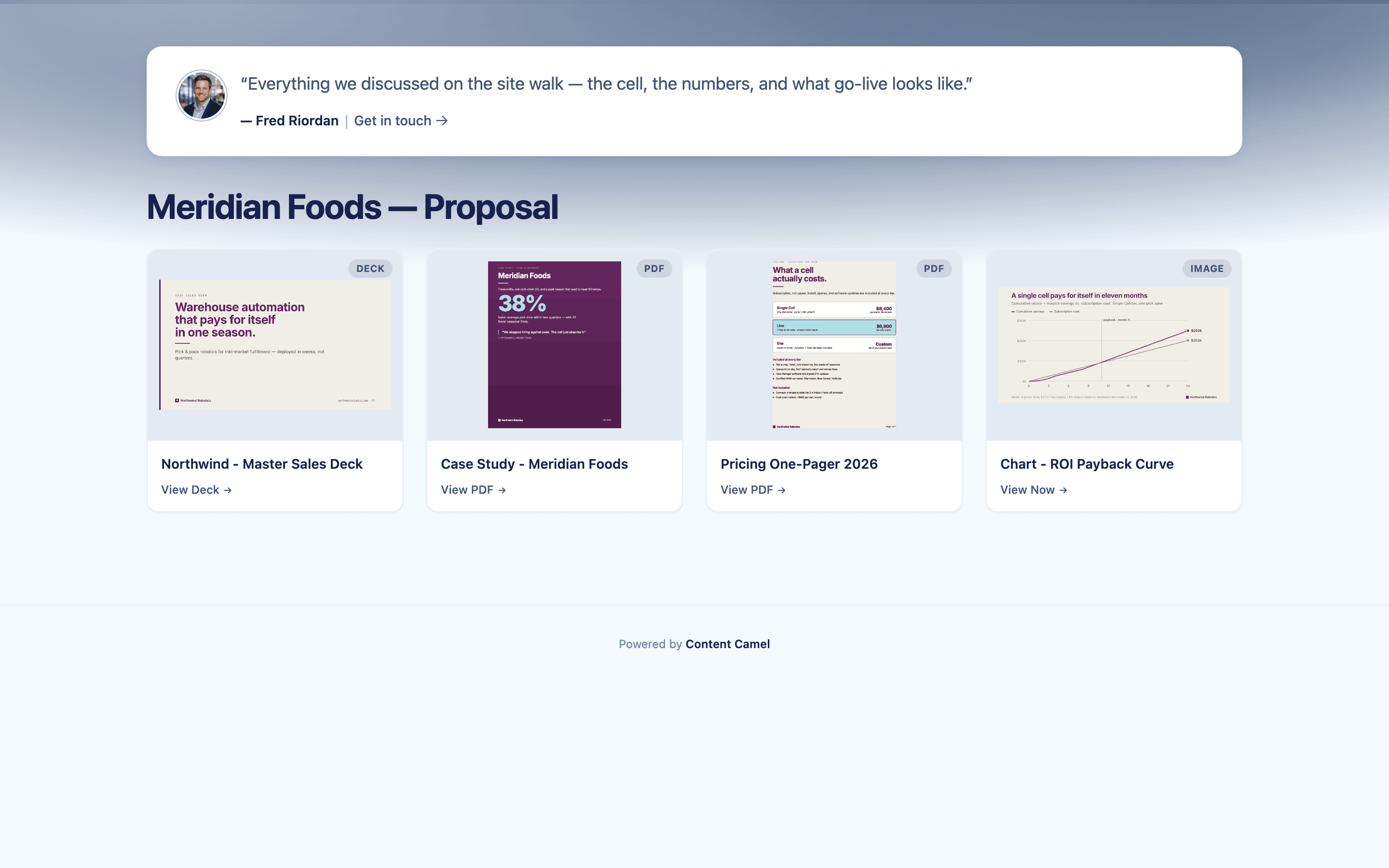
Here’s the scenario I keep coming back to: a prospect needs three videos, a PDF and a deck to move the deal forward. HubSpot’s documents tool makes you generate five separate tracked links, one per file, and hope the prospect works through all five in order. Content Camel does it differently – build a collection, publish it as a branded site, and send one link. All five assets live on that one page instead of scattered across five emails.
Organizing
The library sorts by funnel stage, industry, product, region, type and tags, not folders and an owner field. A rep isn’t left guessing which version is current. Update the asset once, and every collection or site pointing at it shows the new version automatically – with no re-upload to remember in five separate places, a stale pricing deck rarely survives into this quarter’s pitch.
Sharing
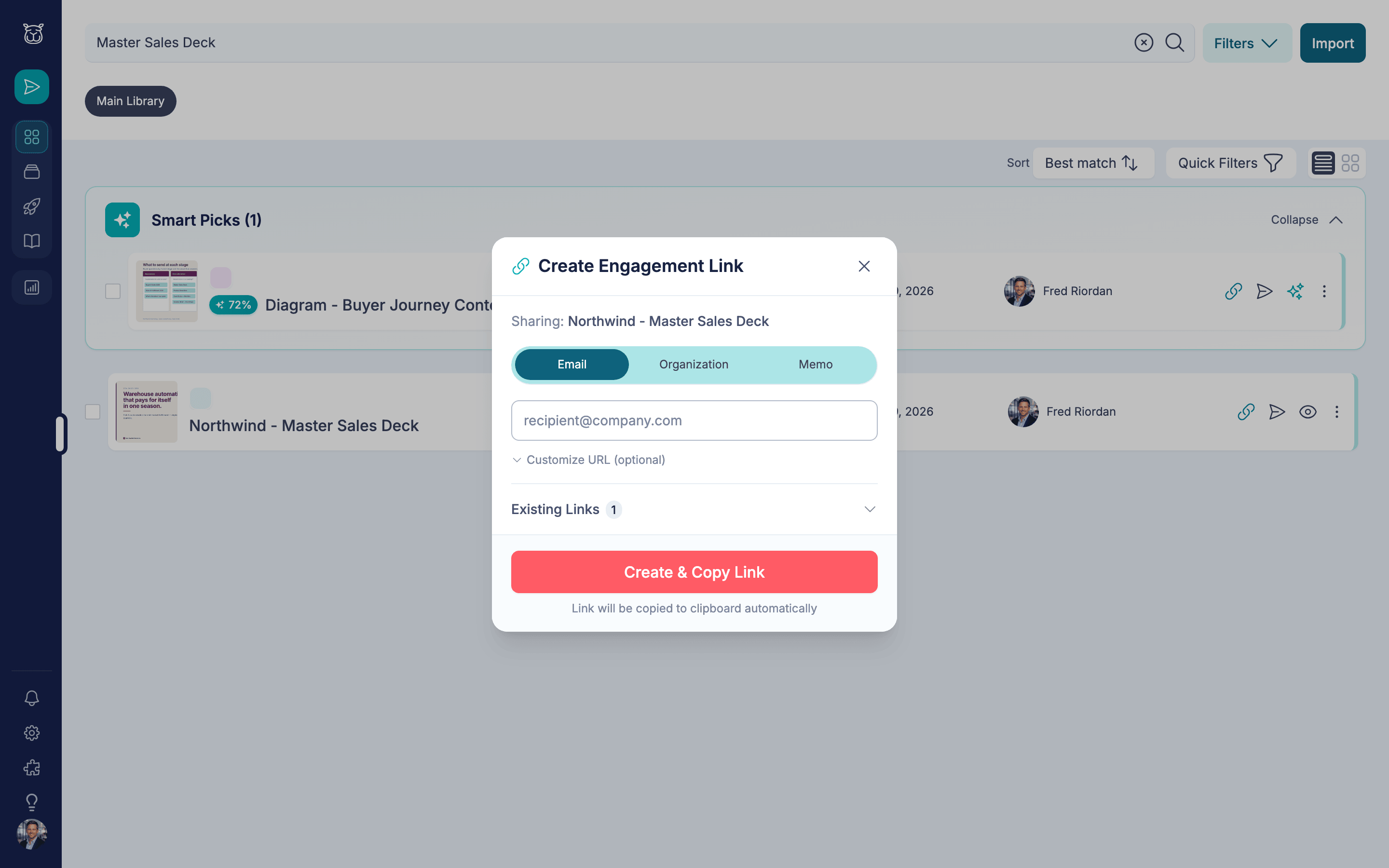
A Content Camel share carries three gates. Stack as many as a deal needs:
- Email – a viewer identifies themselves before they see anything.
- Password – only someone holding it gets past the interstitial.
- Link expiry – set once, when you create the link.
Turn on password and email together, and the visitor sees one combined prompt, not two. A double-prompt bug that used to trip people up on sites-v2 is fixed. Stacking gates doesn’t cost the viewer an extra click.
Reporting
HubSpot tells you a document got opened. Content Camel tells you what happened after. Every share reports sessions and return visits, whoever opens it, however many times. For PDFs specifically, you also get page-level dwell: which page they stopped on and how long, not just one “viewed” timestamp for the whole file. Other asset types report at the session level for now – the per-page breakdown is PDF-only.
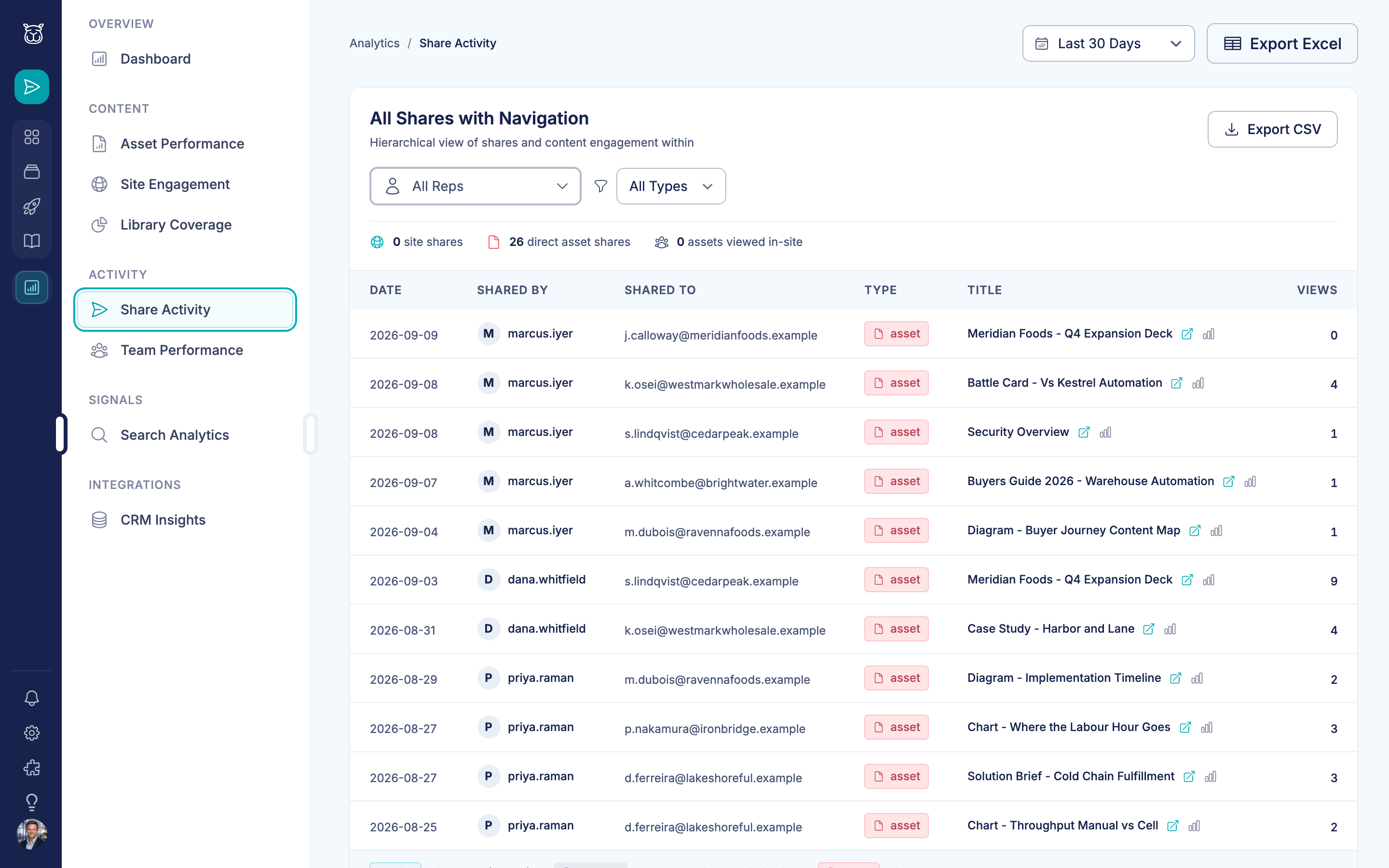
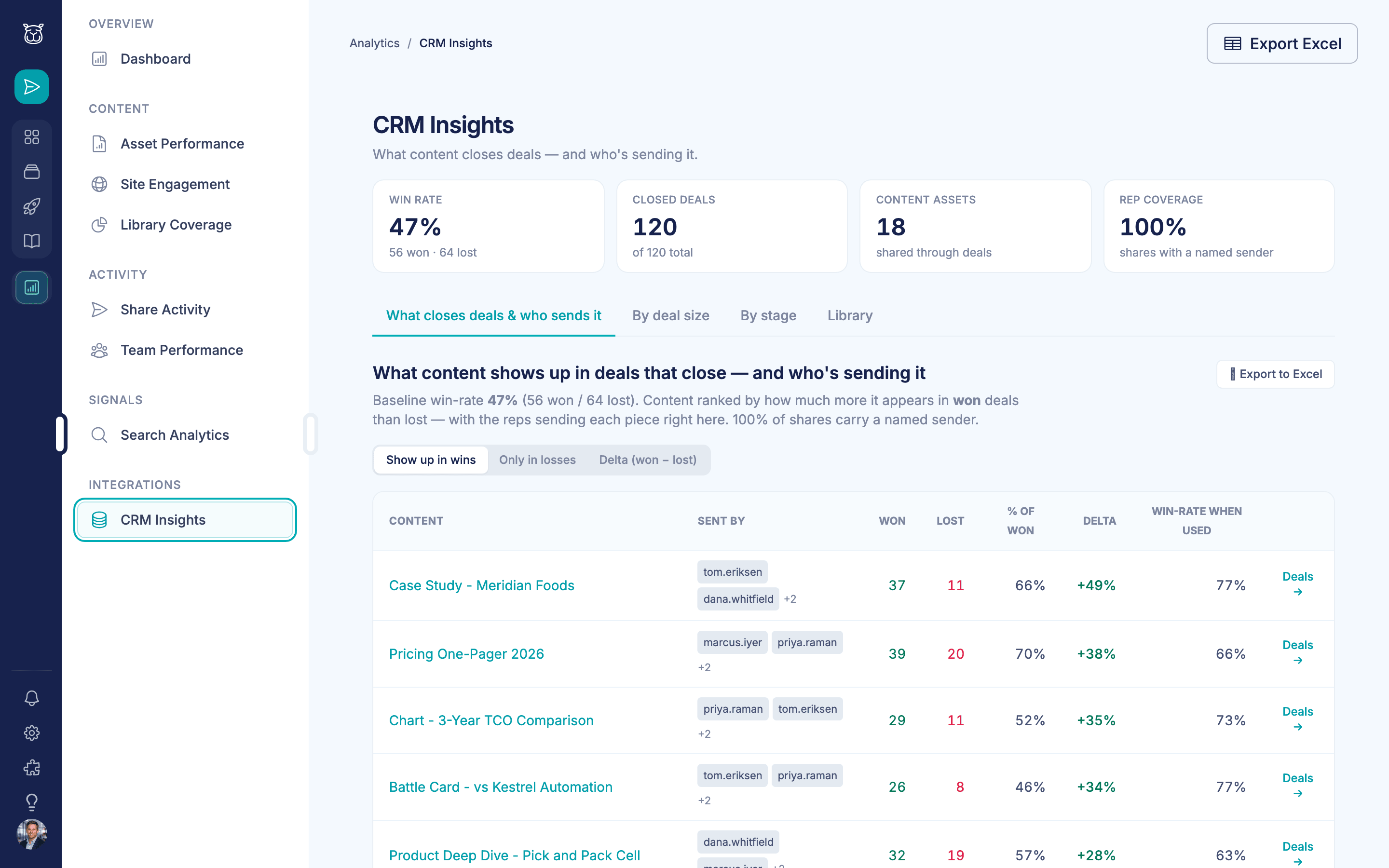
It’s attributed to the sender, not the uploader. A sales director can finally see who’s actually sharing and who’s sitting on the library. Run CRM Insights on top. That activity ties to the deal itself: which assets showed up in deals that closed, and which ones just generated opens that went nowhere.
Want this without changing how reps already work? The free HubSpot Content Report runs read-only against your existing HubSpot data.
About Content Camel
Content Camel aligns content marketing, product marketing, sales enablement in one place: eBooks, datasheets, white papers, blog posts, video. Tags and filters mean reps find it fast, online or in front of a buyer offline.
Free for solo users. Team plans start at $25/user/month, no minimums, no long-term contract.
Want the rest of what HubSpot does well for sales, and where it stops? Read How to use HubSpot for Sales: 11 Winning Ways.
Looking to keep all your marketing content in one place, ready for sales? start a FREE trial of Content Camel now.